






New Mexico Mobile Bartending Laws
New Mexico clearly regulates licensed off-site alcohol service, but its published guidance does not squarely resolve every private, host-supplied dry-hire setup. Use this guide to separate what is verified from what should be confirmed with ABC.
Last reviewed: July 2026 · Educational information, not legal advice
New Mexico Mobile Bartending: Key Facts
| Regulator | New Mexico Regulation and Licensing Department, Alcoholic Beverage Control Division |
| Dry hire | No clear statewide published answer was found for every off-premises, host-supplied private event. Do not sell alcohol; confirm the exact model with ABC.[1] |
| Wet hire | Requires an eligible underlying liquor license and the applicable event permit.[2] |
| Special Dispenser fee | $25 per day for a qualifying private event; $50 per day for a public event.[3] |
| Lead time | Complete event applications must reach ABC at least 10 days beforehand.[3] |
| Maximum duration | Generally 3 days and no more than 12 hours per day.[3] |
| Bartender age | 21 or older; limited service roles may be available at 18–20 in qualifying food-focused establishments.[8] |
| Trailer license | No separate mobile-bar-trailer liquor-license category was found. A trailer is equipment, not licensing authority.[4] |
Choose Your Business Model
Dry Hire: The Cautious Service-Only Model
Keep the transaction genuinely dry hire
- Charge for labor, setup, equipment, mixers, and nonalcoholic supplies.
- Have the host buy, own, transport, and retain all alcohol.
- Do not mark up, bundle, resell, reimburse, or collect money for alcohol.
- Use a written service-only contract that identifies the host as alcohol owner.
- Confirm venue rules, local ordinances, and insurance requirements separately.
Do not assume these are loopholes
- “Free alcohol” included in a package price can still look like an alcohol sale.
- Reimbursement after you buy the alcohol does not keep the host outside the purchase.
- A trailer, van, or folding bar does not create an exemption.
- Tickets, wristbands, donations, memberships, or cover charges can create consideration.
- Never serve a minor or an intoxicated person.
Wet Hire: Existing License Plus Event Permit
New Mexico does not publish a standalone wet-hire “mobile bartending company” license. A Special Dispenser Permit is available only to qualifying dispenser-type liquor license holders and temporarily licenses the approved event area.[2]
$25/day
Invitation-only and limited to people personally known to the sponsor.
$50/day
Open or advertised to the public.
10+ days
A complete application must be received at least 10 days before the event.
Core Special Dispenser requirements
- Event must be in the same local option district as the dispenser license.
- Approved permit, required signs, and floor plan must be posted or followed.
- Only server-certified employees of the license holder may sell, dispense, or serve.
- Provide a detailed floor plan, service boundaries, security placement, and server list.
- Obtain property-owner permission and required local approval.
- Generally limited to 3 days and 12 hours on any one day.
- No alcohol activity outside approved times or boundaries.
- No more than two unconsumed drinks may be sold or served to one person at a time.[6]
Local Option Districts and “Dry County” Questions
A current official list of completely dry New Mexico counties was not found. New Mexico instead operates through local option districts, and municipalities may differ from surrounding county areas. Special Dispenser events must be held in the same local option district as the underlying license, while celebration permits require approval from the local governing body.[9]
New Mexico Rules That Can Surprise Mobile Bartenders
Two-Drink Limit
At covered licensed events, no more than two opened, unconsumed drinks may be sold or served to one person at one time.[6]
Approved Boundaries
Alcohol must remain inside the permitted area. Outdoor areas require physical separation shown on the approved floor plan.
Licensee Employees
For a Special Dispenser Permit, service is limited to certified employees of the license holder seeking the permit.[6]
No Trailer Shortcut
A towable bar may be part of the approved setup, but it does not replace the underlying license or premises approval.
Hours
Statewide licensed on-premises sales and service are generally allowed from 7:00 a.m. to 2:00 a.m. Package sales are generally allowed from 7:00 a.m. to midnight. Restaurant A and B service ends when food service ends or at 11:00 p.m., whichever comes first. A special-event permit may authorize fewer hours.[10]
Health and Food Rules
No mobile-bartending-specific health permit was identified in the reviewed state materials. Food, garnishes, ice, temporary food service, or a trailer build-out may trigger separate Environment Department or local requirements. Confirm those requirements for the actual menu and setup.[11]
Bartender Age and Server Certification
Bartenders
A person under 21 may not be employed as a bartender. Bars, lounges, convenience stores, grocery stores, and package stores use the 21+ rule for alcohol sellers and servers.[8]
Limited Restaurant Service
An 18-to-20-year-old may obtain a permit for qualifying service in a full-service restaurant with meals, but may not work as the bartender.[8]
Plan on Certification
ABC materials include bartenders among people who need server certification, and licensed special events require current server-certified staff working for the license holder.[6]
How to Start a Mobile Bartending Business in New Mexico
Build the business around the model ABC confirms—not around a name such as “mobile bar,” “bartending package,” or “trailer rental.”
Define the Transaction
Write down who buys, owns, transports, serves, and keeps the alcohol—and exactly what appears on your invoice.
Confirm With ABC
For dry hire, ask ABC about the specific private-event and venue scenario. For wet hire, identify the eligible license holder and permit.
Complete Training
Obtain and maintain New Mexico alcohol server certification before working in a role that requires it.
Set Up the Business
Form the entity, register taxes, obtain local business permissions, and use service agreements tailored to the confirmed model.
Insure the Operation
Discuss general liability, liquor liability or host-liquor exposure, vehicle/trailer coverage, workers’ compensation, and venue certificates with an insurer.
Create Event Controls
Use ID tools, refusal logs, hydration, safe transportation contacts, sanitation supplies, and a documented last-call procedure.
New Mexico Mobile Bartending FAQ
Can I operate dry hire without a liquor license?+
Can I buy alcohol and have the client reimburse me?+
Is there a New Mexico mobile bar trailer liquor license?+
Who can apply for a Special Dispenser Permit?+
How much does the event permit cost?+
How early should the application be filed?+
How old must a New Mexico bartender be?+
Does New Mexico have dry counties?+
Equipment and Consumables a Mobile Bar Actually Uses
“What do I need to bring to every event?”
Whether you operate a confirmed dry-hire model or work under an eligible license holder, the equipment list is largely the same. New Mexico events require a professional, sanitary setup that works within the venue’s approved service area.
Core Equipment (Reusable)
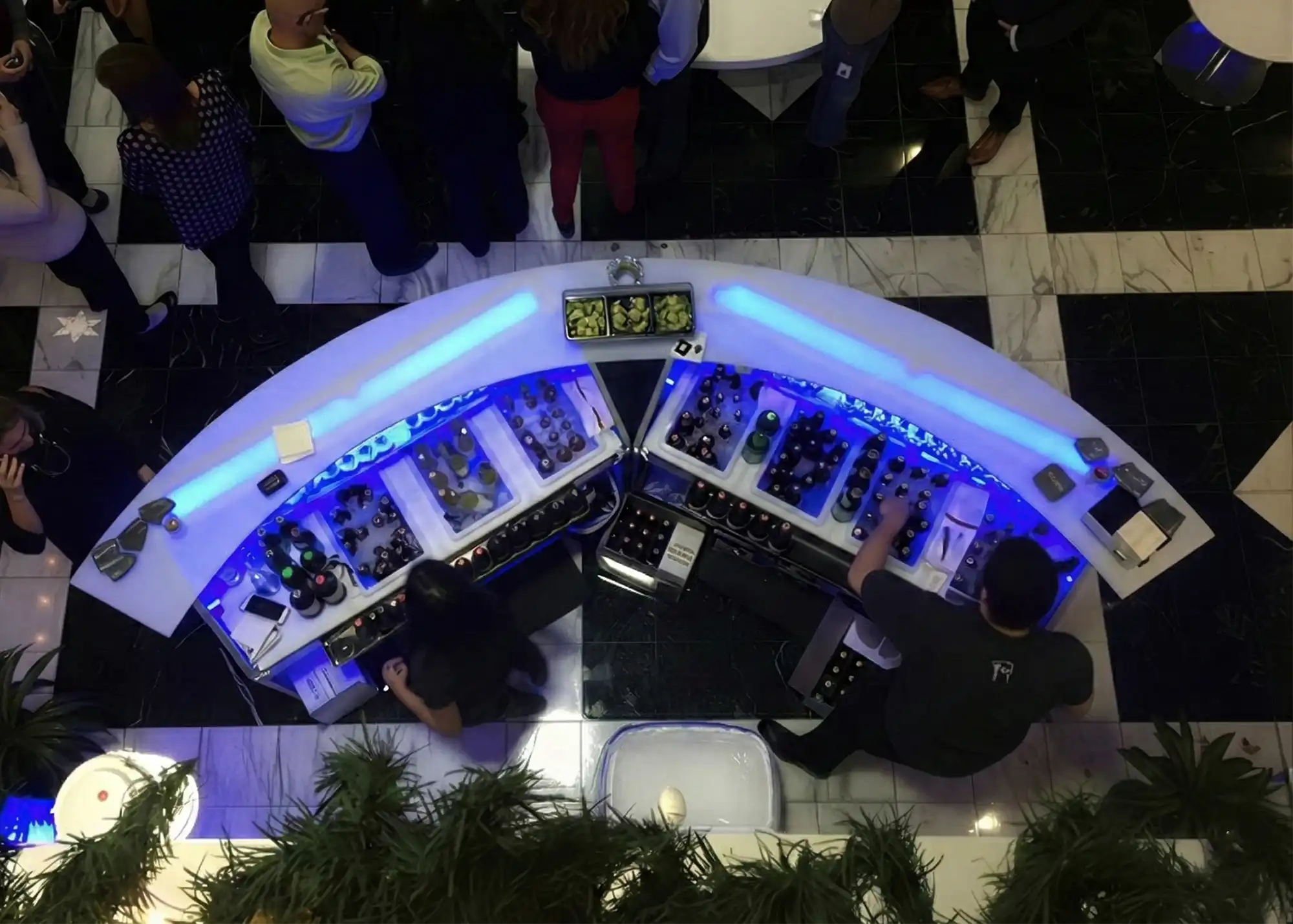
- A portable bar with a food-safe work surface. A 48-inch folding bar fits in an SUV, while a 62-inch LED bar or 77-inch bar handles larger weddings.
- Ice bins with drains. A built-in ice bin keeps ice protected and the service area dry.
- Speed rails and bottle wells for working bottles.
- Bar tools: shakers, strainers, jiggers, muddler, wine key, bar spoons, cutting board, and knife.
- Back bar and transport: a folding back bar and transport case.
- Sanitation: bar towels, sanitizer, handwashing supplies, gloves, trash, and recycling containers.
Consumables (Restocked Every Event)
- Ice: roughly 1 to 1.5 pounds per guest for a full bar.
- Cups or glassware, napkins, and coasters.
- Mixers: sodas, tonic, juices, syrups, sour mix, and bitters.
- Garnishes: citrus, cherries, olives, and fresh herbs.
- Straws, picks, stirrers, and beverage napkins.
- Water station supplies for responsible service.
- CO2 or nitrogen for draft systems or approved batched beverages.
Dry-hire tip: provide the equipment and mixer package while the client purchases the alcohol directly. Keep alcohol purchasing and reimbursement completely outside your invoice.
Your Permit Is Tied to an Approved Place. Your Bar Can Travel Anywhere.
From Albuquerque weddings to Santa Fe galleries and Las Cruces celebrations, a clean professional setup helps venues trust your operation. PortableBar.com has manufactured commercial-grade portable bars in the USA since 2004.
Starting Out: 48-inch Folding Bar
Fits in an SUV and sets up in minutes—ideal for service-only startups.
Weddings & Events: 62-inch LED Bar
Built-in ice-bin options and a polished front presentation.
High Volume: 77-inch Bar
Enough room for two bartenders and larger guest counts.
USA-made equipment since 2004
Official New Mexico Resources
Alcoholic Beverage Control
Agency overview, current laws, alerts, licensing, and program links.
https://www.rld.nm.gov/abc/ → 📅Special Event Permits
Eligibility, fees, timing, floor plans, server lists, and restrictions.
https://www.rld.nm.gov/abc/how-do-i/apply… → 🎓Server FAQ
Server permits, age requirements, renewals, and bartender guidance.
https://www.rld.nm.gov/abc/frequently-asked… → 📝ABC Licensing
NM-PLUS applications, licensing instructions, and official forms.
https://www.rld.nm.gov/abc/licensing/ → 📖Laws and Rules
New Mexico statutes, administrative rules, and local-option materials.
https://www.rld.nm.gov/abc/laws-rules… → 🧹Food Safety Program
Food-establishment and temporary-event sanitation requirements.
https://www.env.nm.gov/foodprogram/ →📖Legal References & Downloads
Full Legal Citations
Dry-Hire Guidance Is Not Conclusive
ABC regulates alcohol sales, service, and public consumption, but the reviewed state materials do not directly answer every off-premises private-host service arrangement. This page therefore labels its dry-hire conclusion as cautious guidance, not an express exemption.
New Mexico ABC overview →Special Dispenser Permit Eligibility
ABC states that Special Dispenser Permits are not issued to private individuals and may be requested only by holders of qualifying dispenser-type liquor licenses.
ABC Special Event Permits →Fees, Deadline, and Duration
ABC lists fees of $25 per day for qualifying private events and $50 per day for public events. A complete application is due at least 10 days beforehand; permits generally cannot exceed three days or 12 hours per day.
ABC Special Event Permits →Premises-Based Licensing and Mobile Equipment
The licensing materials require premises documentation, occupancy rights, zoning information, and floor plans. No separate mobile-bar-trailer liquor-license category was identified; treating the trailer as equipment is an inference from those requirements.
Applicant Requirements (PDF) →Host-Provided Alcohol on Licensed Premises
ABC rules address private parties on licensed premises, including purchase documentation, no sales to guests, service by current permit holders, and operation within authorized hours.
ABC Administrative Rules (PDF) →Certified Employees and Two-Drink Rule
At a Special Dispenser event, only server-certified employees of the license holder may serve. ABC also limits service to no more than two unconsumed drinks for one person at a time.
ABC Special Event Requirements →Craft-Producer Celebration Permits
Eligible New Mexico craft distillers, small brewers, and winegrowers may apply for celebration permits. ABC lists a $10 daily fee plus event documentation, local approval, and certified staffing.
Celebration Permit Requirements →Minimum Age to Bartend
New Mexico’s server guidance states that bartenders must be 21 or older. Workers ages 18–20 may have limited service authority in qualifying full-service restaurants but may not bartend.
ABC FAQ for Servers →Local Option Districts
New Mexico law permits counties and municipalities to act as local option districts. Event eligibility and approvals can therefore depend on the exact municipality or county location.
New Mexico Liquor Control Act (PDF) →Licensed Hours of Service
The Liquor Control Act sets general statewide hours for licensed on-premises service and package sales, with additional limits for restaurant licenses and authority for event permits to use narrower times.
New Mexico Liquor Control Act (PDF) →Food-Safety and Temporary-Event Rules
The Environment Department regulates food establishments and temporary food events. No separate statewide health-code category written specifically for mobile bartending was identified.
New Mexico Food Safety Program →Minors and Intoxicated Persons
The Liquor Control Act prohibits selling, serving, giving, delivering, procuring, or helping provide alcohol to a minor or an intoxicated person.
New Mexico Liquor Control Act (PDF) →Confirm Your Exact Business Model
New Mexico ABC: 505-476-4875 · 2550 Cerrillos Road, Santa Fe, NM 87504/87505