






Wisconsin Mobile Bartending Laws
Wisconsin allows service-only mobile bartending, but it does not issue a roaming liquor or catering license. Selling or supplying alcohol requires a fixed licensed premises, while rented event venues face important new authorization rules beginning in 2026.
Current as of July 2026. Reviewed against Wisconsin DOR Division of Alcohol Beverages guidance and Wis. Stat. Chapter 125.
Wisconsin Mobile Bartending: Key Facts
| Governing system | Wisconsin DOR Division of Alcohol Beverages oversees state law; cities, villages, and towns issue most retail alcohol licenses. |
| Mobile liquor license | None. Retail alcohol licenses attach to permanent, fixed premises and do not travel with a mobile bar. |
| Dry hire | Generally workable when the host owns the alcohol, the bartender charges only for labor/equipment, and the event location is legally authorized for consumption. |
| Bartender credential | Wisconsin calls it an operator’s license or permit. Local licenses work only in the issuing municipality; the newer state permit works statewide. |
| Minimum operator age | 18 years old. |
| Server training | Approved responsible beverage server training is normally required to obtain an operator credential, subject to statutory renewal and recent-license exceptions. |
| Temporary event license | $10, but only qualifying organizations may obtain it; it covers beer and/or wine, not distilled spirits. |
| No-Sale Event Venue Permit | $300 for two years; venue-only permit with a six-day-per-year, one-day-per-month limit. Beer and wine only—no distilled spirits. |
| Cash bars | Not legal at an off-site unlicensed property. The event premises must itself be covered by a retail license authorizing sales. |
Select Your Business Model
Dry Hire: Service-Only Mobile Bartending
Dry hire keeps your company out of the alcohol transaction. The client buys and owns the alcohol, while you charge for labor, equipment, mixers, garnishes, ice, setup, and cleanup. Wisconsin requires a retail license when alcohol is sold, commercially given away, or consumed in a public place without proper authorization. Wisconsin DOR: Retail sales require an appropriate license, and a commercial giveaway can also trigger licensing.
What You May Provide
- Portable bar, ice bins, tools, glassware, and décor
- Bartenders and bar backs
- Ice, mixers, syrups, garnishes, and nonalcoholic drinks
- Menu design, shopping quantities, setup, and cleanup
- Inventory handling after the client has purchased the alcohol
What You Must Not Do
- Buy the alcohol and hide reimbursement inside an invoice
- Operate a cash bar, drink-ticket bar, cup-fee bar, or mandatory-donation bar
- Include alcohol in an all-inclusive package without a licensed pathway
- Bring client-owned alcohol into a retail licensed premises
- Assume a rented venue is legally the same as a private residence
The 2026 Rental Venue Rule
Beginning January 1, 2026, a venue held out to the public for rent generally needs an alcohol beverage license or a No-Sale Event Venue Permit before renters may consume alcohol there. Wisconsin DOR: Rental event venues must obtain an appropriate alcohol authorization beginning January 1, 2026.
Ask every venue: “What Wisconsin alcohol license or permit covers this event, and does it allow client-supplied spirits?” Do not accept “we have always allowed BYOB” as a legal answer.
If the Venue Uses a No-Sale Event Venue Permit
This $300, two-year permit belongs to the venue—not the bartender. It allows alcohol consumption on no more than six days per calendar year and no more than one day per month. It permits beer and wine only; distilled spirits are prohibited. At events with 20 or more attendees, beer or wine must be served by a person holding an operator’s license or permit. DOR Fact Sheet 3122: $300/two years; six days annually; one day monthly; no spirits; operator required for service at 20+ person events.
Practical consequence: A normal client-supplied cocktail bar cannot operate under this permit because vodka, whiskey, rum, tequila, and other distilled spirits are not allowed.
Private Residence vs. Rented Public Venue
A genuinely private, invitation-only event at a residence where no alcohol is sold is the cleanest dry-hire setup. A barn, hall, studio, or other property advertised to the public for rent is treated differently and must have the venue authorization described above. Always confirm local ordinances and the venue’s written alcohol policy.
Wet Hire: There Is No Roaming Wisconsin Liquor License
Wisconsin does not issue a retail alcohol beverage “catering license.” Retail licenses are issued to permanent, fixed locations, do not travel with the catering business, and generally require the retail sale to occur face-to-face on the licensed premises. DOR Fact Sheet 3108: Wisconsin has no retail catering license; retail licenses attach to permanent fixed locations.
Licensed Caterer With Fixed Premises
A statutory caterer may hold Class “B” beer and “Class B” liquor licenses at a permanent location. The customer buys the alcohol face-to-face at that licensed premises; the caterer may later deliver and dispense it at a private catered event that is not open to the public.
- The sale happens at the caterer’s licensed premises—not at the event.
- The catered event cannot operate a cash bar unless the event site itself is licensed for sales.
- Unsold alcohol belongs to the customer and cannot be returned to the caterer.
- A Wisconsin “caterer” must hold a restaurant license and food must exceed 50% of combined food-and-beverage receipts at each event.
Qualified Organization Holds Temporary License
A qualifying nonprofit or civic organization may obtain a Temporary Class “B” beer and/or Temporary “Class B” wine license for an event. The organization—not your mobile bartending company—holds the license and controls the alcohol sales.
- License fee: $10 for beer, wine, or both.
- Beer and wine only; no distilled spirits.
- The municipality approves the premises and may add background-check fees.
- Your company may be hired for equipment and labor under the license holder’s control.
A Cash Bar Changes the Legal Analysis
If guests pay per drink, buy tickets, pay a cover that includes alcohol, or make a required “donation,” the alcohol is being sold. An off-site caterer cannot conduct those sales at an unlicensed property. The event premises itself must be licensed or temporarily licensed for the transaction. DOR catering guidance: Cash bars are illegal at catered events unless a retail license authorizes alcohol sales on that event premises.
No Dry-County List—Licensing Is Municipal
Wisconsin does not use a simple statewide list of dry counties for this decision. Cities, villages, and towns decide whether to issue retail licenses, and “Class B” liquor licenses may be limited by municipal quotas. Check the exact municipality and event premises before quoting wet-hire service. Wisconsin DOR: Municipalities issue retail licenses and may choose whether to grant them; liquor licenses can also be quota-limited.
Search Wisconsin retail alcohol licenses by premisesCommon Regulatory Traps in Wisconsin
The “Catering License” Myth
There is no mobile catering liquor license. A true alcohol caterer first needs a qualifying restaurant operation and fixed Class “B” licenses. A trailer, van, or folding bar does not become a licensed premises merely because it is mobile.
BYOB at a Licensed Venue
Guests generally may not carry their own alcohol into retail licensed or permitted premises. The venue must use alcohol purchased through its authorized source, subject to narrow statutory exceptions. DOR Fact Sheet 3105: Carry-ins are generally prohibited at licensed or permitted premises.
The Reimbursement Trick
Buying alcohol yourself and labeling the charge “reimbursement,” “shopping,” or “materials” does not turn the transaction into dry hire. If your business provides alcohol for consideration, treat it as a regulated sale.
The Old Venue Policy Trap
A venue saying “we have always allowed outside alcohol” is no longer enough. Beginning in 2026, public rental venues generally need a retail license or the limited No-Sale Event Venue Permit.
Local Bartender License Portability
A municipal operator’s license works only in the municipality that issued it. Mobile operators working statewide should consider the state-issued operator’s permit instead of collecting separate local credentials.
Serving an Intoxicated Guest
Wisconsin prohibits procuring, selling, dispensing, or giving alcohol to an intoxicated person. Violations can carry fines of $100 to $500, up to 60 days in jail, or both. Wis. Stat. 125.07(2): Prohibits furnishing alcohol to an intoxicated person and provides criminal penalties.
Does Wisconsin Require a Bartending License?
Yes, in many licensed or permitted event settings. Wisconsin calls the credential an operator’s license or operator’s permit. A municipal operator’s license is valid only within the issuing city, village, or town. Since January 1, 2025, bartenders may instead obtain a state-issued operator’s permit valid at licensed or permitted premises anywhere in Wisconsin. DOR Fact Sheet 3104: Explains local operator licenses, statewide permits, qualifications, training, and supervision.
At a genuinely private, unlicensed residence where no retail sale occurs, Wisconsin’s operator rules do not ordinarily create the same licensing requirement because operator credentials govern service at licensed or permitted premises. Training and a statewide permit are still sensible for a professional who works at many different venues.
Minimum age to obtain an operator credential
Valid only in the issuing municipality
Valid at licensed or permitted premises statewide
Not Every Server Must Hold One
An adult server may work under the immediate supervision of a qualified licensee, agent, manager, or operator. Immediate supervision means the credentialed person must be in the same room or area, close enough to see, speak with, and actually supervise the unlicensed server. For a mobile company, having every lead bartender credentialed is the safer operational practice.
Training Requirement
Applicants normally must complete a Wisconsin-approved responsible beverage server course. Exceptions include qualifying renewals, recent course completion, or having held certain Wisconsin alcohol credentials within the previous two years. Course prices vary by approved provider.
How to Start a Mobile Bartending Business in Wisconsin
The practical checklist, in order.
- Choose your model first. Dry hire is the realistic starting point for most standalone mobile bartenders. Wet hire requires a fixed licensed premises, a qualifying catering operation, or work under another license holder.
- Form the business. A Wisconsin LLC costs $130 to organize online or $170 by paper. The online annual report fee is $25. Wisconsin DFI: Current domestic LLC formation and annual report fees.
- Get an EIN. Apply directly through the IRS for free. Avoid third-party sites charging for the same application.
- Register tax accounts when required. Wisconsin’s Business Tax Registration fee is generally $20 for the first covered permit or certificate. Determine with your accountant whether your equipment rentals, products, or taxable sales require a seller’s permit. Wisconsin DOR: The $20 Business Tax Registration fee applies to most covered certificates and permits.
- Complete approved server training. Then obtain municipal operator licenses where you work or apply for the statewide operator’s permit through My Tax Account.
- Build a venue-verification step into every quote. Record whether the event is a private residence, licensed premises, or public rental venue. Ask for the exact license or permit and confirm whether client alcohol, spirits, and outside bartenders are allowed.
- Use a dry-hire contract. State that the client purchases, owns, transports, and retains the alcohol; your fee covers labor, equipment, and nonalcoholic supplies only.
- Buy insurance. Carry general liability and liquor liability or host-liquor coverage appropriate to your role. Many venues will require a Certificate of Insurance and additional-insured endorsement.
- Buy commercial-grade mobile equipment. Choose equipment that can be sanitized, transported safely, and set up without using the venue’s licensed storage or service areas unless the venue approves it.
Age Requirements & Staffing
| Role | Minimum Age | Requirements |
|---|---|---|
| Operator License/Permit Holder | 18 | Must meet statutory qualifications and normally complete approved server training. |
| Supervised Adult Server | 18 | May work without an individual operator credential only under immediate, in-area supervision by a qualified person. |
| No-Sale Venue Event, 20+ Guests | 18 | Beer and wine service must be performed by someone holding an operator’s license or permit. |
| Alcohol Consumer | 21 | Wisconsin has a narrow parental/guardian/spouse exception, but the licensee may refuse it and professional event policies commonly remain strictly 21+. |
Wisconsin’s Underage Accompaniment Exception
State law may allow a person under 21 to possess or consume alcohol when accompanied by a parent, guardian, or spouse of legal drinking age, but a retail licensee may prohibit it. A mobile bartender should never make this call independently; follow the license holder’s written policy and verify local rules. Wisconsin DOR: Explains the accompanied-underage exception and the licensee’s discretion to prohibit it.
Closing Hours
Class “B” premises generally close from 2:00 a.m. to 6:00 a.m. On Saturday and Sunday mornings, closing begins at 2:30 a.m.; special rules apply when daylight saving time begins and on January 1. Municipalities may impose stricter rules. Wis. Stat. 125.32(3): Establishes Class B closing hours and exceptions.
Common Questions & “Loophole” Myths
Dry Hire & Venues
Do I need a liquor license for Dry Hire in Wisconsin?▼
Generally, no retail license is needed for your service company when the client purchases and owns the alcohol and you charge only for labor, equipment, and nonalcoholic supplies. The event location must still be legally authorized for consumption.
Can I buy the alcohol and bill the client back?▼
Do not treat that as dry hire. Reimbursement does not erase the alcohol transaction. Require the client to purchase directly or operate through a legally licensed caterer, venue, or event license holder.
Does a wedding venue need its own permit if the couple supplies the alcohol?▼
Beginning January 1, 2026, venues held out to the public for rent generally need an appropriate retail license or No-Sale Event Venue Permit. The limited no-sale permit allows beer and wine but prohibits distilled spirits.
Can guests bring alcohol into a licensed venue?▼
Generally no. Retail licensed or permitted premises normally may possess only alcohol obtained through authorized sources. Confirm any claimed exception with the license holder and municipality before the event.
Wet Hire & Sales
Does Wisconsin have a mobile liquor license?▼
No. Retail licenses attach to a permanent, fixed premises. A portable bar or trailer is equipment, not a roaming licensed premises.
Can a licensed caterer provide the alcohol?▼
Yes, if the business qualifies as a Wisconsin caterer and holds appropriate fixed-premises retail licenses. The customer must buy the alcohol face-to-face at the caterer’s licensed premises before delivery to the private event.
Can I operate a cash bar at an off-site wedding?▼
Only if the event premises itself is covered by a retail or temporary license authorizing sales. A caterer’s fixed license does not travel to the wedding site.
Can a nonprofit get a one-day license?▼
A qualifying organization may apply through the municipality for a $10 temporary beer and/or wine license. It does not authorize distilled spirits, and the organization—not the bartending contractor—holds the license.
Bartender Credentials & Service
Do Wisconsin bartenders need an operator’s license?▼
Licensed and permitted premises must have a qualified licensee, agent, manager, operator, or provisional operator present. Other adults may serve only under that person’s immediate supervision. No-sale venue events with 20 or more attendees specifically require licensed or permitted operators to serve beer and wine.
Should a mobile bartender get the statewide permit?▼
Usually, yes, if you regularly work across municipal lines. A municipal operator’s license is valid only in the issuing municipality, while the state permit is valid at licensed or permitted premises throughout Wisconsin.
How old must a bartender be?▼
At least 18 years old to obtain an operator’s license or permit and to work as an adult server under Wisconsin’s operator-supervision rules.
Is server training required?▼
Normally yes for an operator credential, although Wisconsin provides exceptions for certain renewals, recent course graduates, and people who recently held qualifying Wisconsin alcohol credentials.
Can someone under 21 drink with a parent in Wisconsin?▼
Wisconsin has an accompanied-underage exception involving a parent, guardian, or spouse of legal drinking age, but the retail licensee may prohibit it. Mobile bartenders should follow a strict written policy and never decide this independently at the bar.
What are Wisconsin’s closing hours?▼
Class “B” premises generally close at 2:00 a.m., with 2:30 a.m. closing on Saturday and Sunday mornings. Daylight-saving and January 1 exceptions apply, and local rules can be stricter.
Equipment and Consumables a Mobile Bar Actually Uses
“What do I need to bring to every event?”
Whether you operate dry hire or work under another license holder, your equipment list is largely the same. Wisconsin venues expect a professional, sanitary setup that can be transported without disrupting their licensed service areas.
Core Equipment (Reusable)
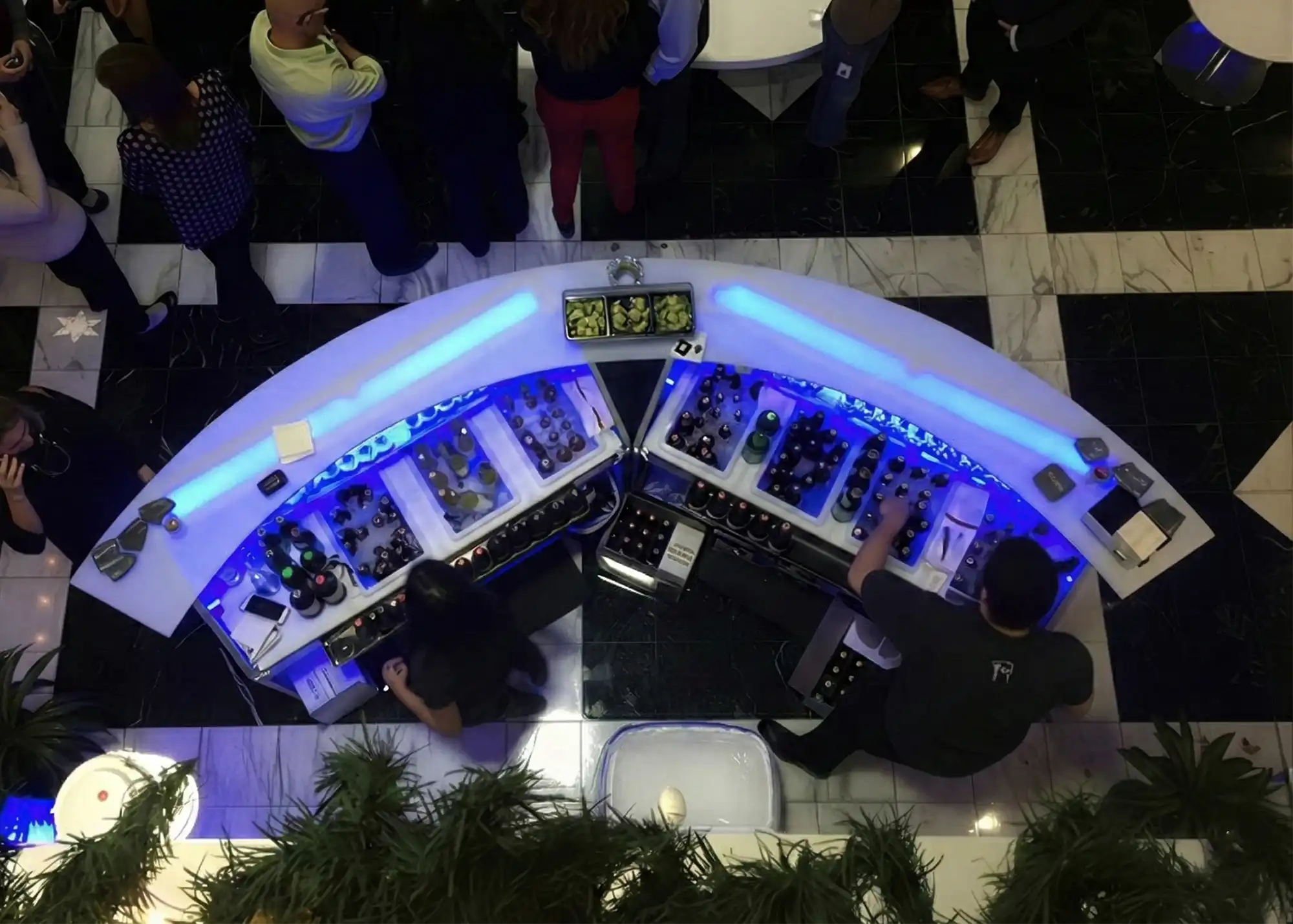
- A portable bar with a food-safe work surface. A 48-inch folding bar fits in an SUV, while a 62-inch LED bar or 77-inch bar handles larger weddings.
- Ice bins with drains. A built-in ice bin keeps ice protected and the service area dry.
- Speed rails and bottle wells for working bottles.
- Bar tools: shakers, strainers, jiggers, muddler, wine key, bar spoons, cutting board, and knife.
- Back bar and transport: a folding back bar and transport case.
- Sanitation: bar towels, sanitizer, handwashing supplies, gloves, trash, and recycling containers.
Consumables (Restocked Every Event)
- Ice: roughly 1 to 1.5 pounds per guest for a full bar.
- Cups or glassware, napkins, and coasters.
- Mixers: sodas, tonic, juices, syrups, sour mix, and bitters.
- Garnishes: citrus, cherries, olives, and fresh herbs.
- Straws, picks, stirrers, and beverage napkins.
- Water station supplies for responsible service.
- CO2 or nitrogen for draft systems or approved batched beverages.
Dry-hire tip: provide the full equipment and mixer package while the client purchases only the alcohol. Keep the alcohol purchase completely outside your invoice.
Your License May Be Tied to a Premises. Your Bar Does Not Have to Be.
From Milwaukee weddings to Madison corporate events and Door County receptions, a clean professional setup helps venues trust your operation. PortableBar.com has manufactured commercial-grade portable bars in the USA since 2004.
Starting Out: 48-inch Folding Bar
Fits in an SUV and sets up in minutes—ideal for dry-hire startups.
Weddings & Events: 62-inch LED Bar
Built-in ice-bin options and a polished front presentation.
High Volume: 77-inch Bar
Enough room for two bartenders and larger guest counts.
USA-made equipment since 2004
Official Wisconsin Resources
Legal References & Downloads
Full Legal Citations
When a Retail License Is Required
Wisconsin DOR, Alcohol Beverage Laws for Retailers—Licenses.
View official guidance Back to citation2026 Event Venue Implementation
Wisconsin DOR, Event Venue Alcohol Beverage Law Implementation.
View official notice Back to citationNo-Sale Event Venue Permit
Wisconsin DOR Fact Sheet 3122; Wis. Stat. 125.24.
View fact sheet Back to citationNo Mobile Catering License
Wisconsin DOR Fact Sheet 3108, Catering Alcohol Beverages.
View fact sheet Back to citationTemporary Beer & Wine License
Wisconsin DOR Form AB-220 and Fact Sheet 3101.
View application Back to citationMunicipal Retail Licensing
Wisconsin DOR Publication 302 and retail licensing guidance.
View publication Back to citationOperator Licenses & Statewide Permits
Wisconsin DOR Fact Sheet 3104; Wis. Stat. 125.17 and 125.175.
View fact sheet Back to citationWisconsin LLC Fees
Wisconsin Department of Financial Institutions, Corporation Fees.
View fee schedule Back to citationBusiness Tax Registration
Wisconsin DOR, Business Tax Registration common questions.
View official guidance Back to citationUnderage Accompaniment Exception
Wisconsin DOR, Underage Alcohol Questions; Wis. Stat. 125.07.
View official FAQ Back to citation