




Pennsylvania Licensing & Compliance
State: PennsylvaniaDo I Need a License for Mobile Bartending in Pennsylvania?
The short answer: Pennsylvania is a “Control State” with strict enforcement. You generally cannot license a mobile bar directly. You operate either as a “Dry Hire” service (no permit needed if rules are met) or by “piggybacking” on a brick-and-mortar license.
Last Updated: February 2026
The Pennsylvania Landscape at a Glance
The Pennsylvania Liquor Control Board (PLCB) regulates licensing, while the State Police Bureau of Liquor Control Enforcement (BLCE) handles enforcement. In PA, the definition of a “Sale” is very broad, meaning you have to be extremely careful about “Consideration” (money changing hands).
1. Dry Hire (Service Only)
The Model: You provide labor and mixology. The host buys the alcohol.
License Needed: None (If alcohol is “Truly Free”).
2. Wet Hire (Sales)
The Model: You sell alcohol or provide a full package.
License Needed: Off-Premises Catering Permit (Must have existing Liquor License).
Start your business with the right foundation.
Browse LED Lighted Portable Bars →The “Dry Hire” Rules
“I am just the service. The host provides the drinks.”
In Pennsylvania, you can operate a mobile bartending service without a liquor license, but only if you strictly adhere to the concept of “Truly Free Alcohol.”
The “Truly Free” Standard
According to PLCB legal guidance, a non-licensed entity (you) can serve alcohol only if it is free. However, “Free” is defined very strictly. [Ref] PLCB Guidance:
“The alcohol must ‘truly be free,’ meaning it cannot be conditioned on an admission ticket, donation, purchase of a meal, or payment of any other fee.”
Source: PLCB Legal FAQs (Free Drinks)
It is NOT “Free” if:
- Guests pay an admission fee or buy a ticket to enter the event.
- Guests are asked for a “donation” or “tip” in exchange for a drink.
- The cost of the alcohol is hidden in the price of a meal or ticket.
Dry Hire Constraints
If the event is truly private (like a wedding where the couple pays for everything), you can serve the alcohol they purchased. You cannot purchase the alcohol for them and get reimbursed, as that constitutes a “Sale” (transfer for consideration), which requires a license.
The “Wet Hire” Reality
“I want to sell alcohol at festivals and public events.”
This is extremely difficult for independent operators in PA. Unlike states with temporary permits for anyone, Pennsylvania restricts alcohol sales privileges to specific entities.
The Two Main Pathways
- NON-PROFITSSpecial Occasion Permit (SOP): This allows the sale of alcohol, but it is restricted to “Eligible Entities” (typically non-profits, fire departments, museums).
Cost: $30 per day.
Constraint: A private for-profit mobile bar company generally cannot get this permit. You would have to be hired by the non-profit to work their permitted event. [Ref] SOP Eligibility:
“Eligible entities under the Liquor Code… Only the named SOP holder is authorized to sell.”
Source: PLCB SOP Guidelines - LICENSEESOff-Premises Catering Permit (OPCP): This allows an entity that already holds a liquor license (like a restaurant or hotel) to cater off-site.
Cost: $500 annually.
Constraint: You cannot get this permit for a standalone mobile bar business. You must own a licensed brick-and-mortar establishment first. - RESTRICTIONThe “Mobile” Ban: PLCB guidance explicitly states that an Off-Premises Catering Permit “shall not be issued… for use in any location that is mobile.” This means you cannot license a food truck or trailer as the “premises” itself. [Ref] PLCB Guidance:
“A permit shall not be issued… for use in any location that is mobile.”
Source: PLCB Conducting Special Events FAQ
Operational Rules You Can’t Ignore
Staffing & Age
Licensed Venues: 18+ to serve.
Unlicensed (Dry Hire): 21+ to serve.
This is a critical distinction in PA. While an 18-year-old can bartend at a restaurant, PLCB guidance states it is not permissible for an unlicensed establishment (like a Dry Hire wedding) to have anyone under 21 serve alcohol. [Ref] Unlicensed Service Age:
“It is not permissible for an unlicensed establishment to have any person under the age of 21 serve alcohol.”
Source: PLCB Free Drinks FAQ
RAMP Certification: The “Responsible Alcohol Management Program” is voluntary for Dry Hire but highly recommended to demonstrate due diligence.
Location & Zoning
Dry Municipalities: PA does not have “Dry Counties,” but it has over 675 “Dry Municipalities” (towns/boroughs) where alcohol sales are restricted. You must check the local status of the specific town where the event is held. [Ref] Dry Municipalities:
“As of July 2025, about 675 of 2,560 Pennsylvania municipalities are at least partially dry.”
Source: PLCB Wet and Dry Municipalities
Hours:
• Standard stop time is 2:00 AM.
• Premises must be vacated by 2:30 AM.
Common Questions & “Loophole” Myths
Can I have a tip jar out? ▼
Be very careful. In an unlicensed (Dry Hire) setting, the PLCB requires alcohol to be “truly free.” If a tip jar implies that a “donation” is expected in exchange for the drink, enforcement agents can construe that as an illegal sale.
The Alternative: Build a gratuity into your service fee charged to the host, or simply pay your staff a higher hourly rate and market your service to the client as “No Tipping Required,” which adds a touch of class to their wedding.
Can I charge for mixers, ice, cups, and garnishes? ▼
Yes. You are a service business selling non-alcoholic goods and labor. You can invoice the client for “Bar Setup Packages” that include sodas, fruit, ice, and glassware. As long as the invoice does not include the cost of the alcohol itself, you are operating legally.
What is the benefit of RAMP training if I’m not licensed? ▼
Liability protection and professionalism. Even if not mandatory for Dry Hire, being RAMP-certified shows venues and clients that you know the law regarding minors and visible intoxication. It can also help lower your general liability insurance premiums and provides a “good faith” defense if an incident ever occurs at an event you worked.
Does PA differentiate between folding bars and mobile trailers? ▼
Legally, no; Logistically, yes. Neither one can hold a liquor license itself. However, because trailers cannot enter most buildings, they are limited to outdoor events. A modular folding bar (like ours) allows you to work year-round by moving indoors for winter weddings and corporate parties, which is crucial in Pennsylvania’s climate.
Can I buy the alcohol for the client and get reimbursed? ▼
No. In Pennsylvania, any “transfer for consideration” (money changing hands) is considered a sale. If you buy the alcohol and the client pays you back, you have effectively “sold” them the alcohol without a license. The client must purchase the alcohol directly.
Professional Gear for PA Events
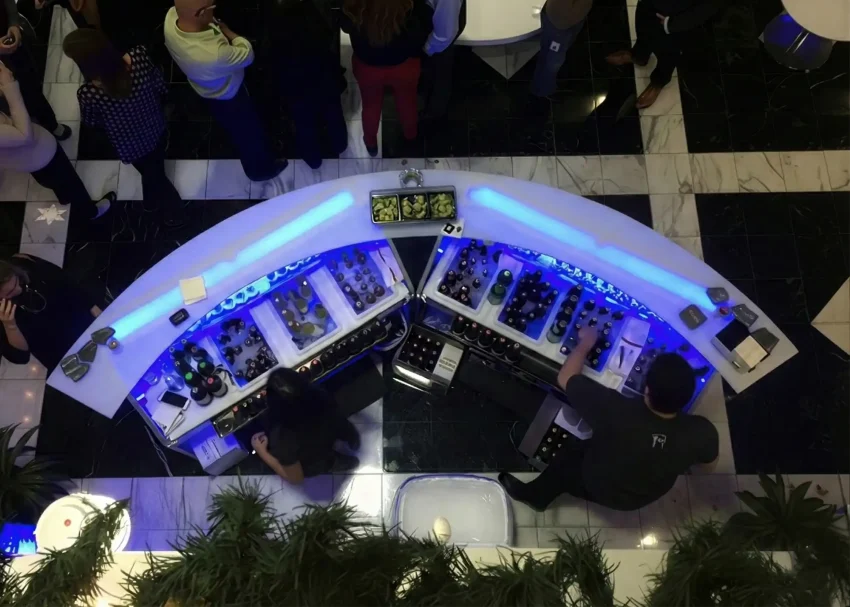
Since you cannot attach a liquor license to a mobile trailer in PA (it must be a fixed building), many pros use modular bars that can go inside venues where trailers can’t fit.
Indoor Friendly
Since many “Dry Hire” events move indoors to private halls, our bars fit through standard doors and elevators.
Rapid Deployment
Set up a full commercial bar station in under 2 minutes, allowing you to handle multiple events in a single weekend.
Customizable Aesthetics
Interchangeable branding panels and integrated LED lighting allow you to match the bar to the venue’s decor, elevating your service above a simple table setup.