






Oregon Mobile Bartending Laws
Oregon’s OLCC enforces strict control-state rules with mandatory CAMP digital applications requiring 2-4 week lead times. The wet hire model demands food service and health-code compliant trailers.
Current as of February 2026 • Reflects 2025 Service Permit Changes
Choose Your License Path
Bottom Line: No OLCC license needed if you’re not selling alcohol. You provide bartending labor and equipment while the host owns the alcohol. All bartenders still need Service Permits.
The Service Model
Dry Hire means you provide bartending expertise, portable bars, glassware, and mixers—but the host purchases and owns all alcohol. Since no “sale” occurs by your company, you avoid OLCC’s licensing requirements entirely. Sale Definition:
ORS 471.406 defines “sale” as any exchange of consideration for alcohol. In Dry Hire, no such exchange occurs by the bartender.
Full citation below
Mandatory Requirement:
Every individual serving alcohol must have an Alcohol Service Permit—even in Dry Hire. The 45-day grace period was eliminated in 2025. Service Permit Mandate:
“Every individual involved in service or sale of alcohol must hold a Service Permit. New 2025 rule: Staff must be certified before first shift.”
Full citation below
What You CANNOT Do
No Purchasing for Resale: You cannot buy alcohol and bill the host—even at cost. This is “resale” and requires a license. Resale Prohibition:
Purchasing alcohol with intent to resell (even to client) without a license violates ORS 471.405.
Full citation below
No Public Events Without Host License: If the host sells tickets or charges cover, it’s commercial. The event needs an OLCC license. Private vs Public:
Private events with no guest charges are exempt. Commercial events require licensing even if bartender is “Dry Hire.”
Full citation below
Dram Shop Liability Still Applies: You’re liable for serving visibly intoxicated persons even though you don’t own the alcohol. VIP Liability:
Oregon’s Dram Shop law (ORS 471.565) holds servers liable for serving visibly intoxicated persons who cause harm.
Full citation below
Bottom Line: Selling alcohol requires either a TSL (Temporary Sales License) for single events or an F-CAT (Full On-Premises Caterer) annual license. Both require 2-4 weeks processing through CAMP system.
Oregon’s Huge Advantage Over Most States
Unlike Nevada, West Virginia, and most other states that require an existing brick-and-mortar restaurant to sell alcohol at events, Oregon’s TSL and F-CAT licenses have NO brick-and-mortar requirement. You can start a mobile bar business without owning a restaurant.
- ✓ No restaurant needed – Apply as a standalone mobile bar company
- ✓ No daily operating requirement – Other states require restaurants to operate daily
- ✓ Lower barrier to entry – Start wet hire without $100k+ restaurant investment
License Comparison
| Feature | TSL (Temporary) | F-CAT (Annual) |
|---|---|---|
| Duration | Single event (1-7 days) | Annual renewable |
| Cost | $50 per day TSL Fee: Temporary Sales License charges $50 per day of event. Full citation below | $800/year F-CAT Fee: Full On-Premises Caterer license is $800 annually. Full citation below |
| Best For | Occasional events, festivals | Professional mobile bar businesses |
| Application | Per event through CAMP | Once annually, TUALs for public events |
| Insurance | Recommended | $300k liquor liability REQUIRED Insurance Mandate: F-CAT requires proof of $300,000 liquor liability insurance with OLCC as certificate holder. Full citation below |
| Processing Time | Both require 2-4 weeks through CAMP with local endorsement CAMP Lead Time: Digital system enforces minimum 2-week processing. Spontaneous bookings legally impossible without advance paperwork. Full citation below | |
🍽️ Mandatory Food Service
You MUST provide at least 2 different substantial food items whenever alcohol is served. “Substantial” means meal portions—sandwiches, burgers, pizzas. Pretzels and nuts don’t count. Food Mandate:
“For licensees, there must be at least two different substantial food items available at all times alcohol is served.”
Full citation below
🚐 Mobile Food Unit License
If using a trailer, you need an OHA Mobile Food Unit license (Class II-IV). Requirements: integral water tanks, hot water heater (100°F min), 3-compartment sink, commissary contract. MFU Requirements:
“Mobile units must have integral freshwater/wastewater tanks, water heaters capable of 100°F, and smooth cleanable surfaces per OAR 333-162.”
Full citation below
⚠️ Oregon-Specific Pitfalls
Oregon’s control-state system and strict enforcement create unique compliance challenges.
1. The CAMP System Trap
The digital CAMP portal requires 2-4 weeks minimum processing. You CANNOT book last-minute events—the system won’t accept late applications. Wedding in 10 days? Too late. Digital Enforcement:
“CAMP system enforces hard stops on non-compliant applications. Spontaneous event bookings legally impossible if 2-4 week window missed.”
Full citation below
2. The Stacking Prohibition
You cannot serve more than 2 drinks to a single person at one time. No buckets of 5 beers. No shot-beer-cocktail combos. Maximum 2 drinks. Period. 2-Drink Limit:
“OLCC rules prohibit serving a single patron more than two drinks at any one time.”
Full citation below
3. The 18-20 Mixing Ban
Staff aged 18-20 can serve alcohol but CANNOT mix drinks. They can pour wine or pull a tap, but the act of cocktail creation requires being 21+. Minor Mixing Prohibition:
“A minor service permit holder may not mix drinks. They can pour wine or draw beer, but cocktail creation is reserved for 21+.”
Full citation below
Age Rules & Service Permits
Oregon has specific restrictions on who can mix drinks versus who can serve them.
| Age | What’s Allowed | Restrictions |
|---|---|---|
| 21+ Years | Full Bartending | Can mix, serve, and sell all types of alcohol without restrictions. Must hold Service Permit. 21+ Full Rights: Anyone 21+ can perform all bartending duties including mixing cocktails. Full citation below |
| 18-20 Years | Serve Only | Can serve/pour wine and beer. CANNOT mix drinks or act as primary bartender. Cannot remain in 21+ areas. 18-20 Restrictions: “Minor Service Permit holders may not mix drinks or act as bartender. Can pour wine/beer only.” Full citation below |
| All Ages | Service Permit | Every person serving alcohol must have Service Permit BEFORE first shift (2025 rule change—no grace period). No Grace Period: “New 2025 legislation eliminated 45-day grace period. Staff must be fully certified before first shift.” Full citation below |
Common Questions
Dry Hire Basics
Do I need a liquor license for Dry Hire in Oregon? ▼
NO OLCC LICENSE. But every individual serving alcohol (even in Dry Hire) must have an Alcohol Service Permit. No exceptions—staff must be certified before their first shift.
Can I buy alcohol for my client and charge them for it? ▼
ABSOLUTELY NOT. This is “resale” without a license under ORS 471.405. The host must make their own purchase directly from a licensed retailer.
Am I liable if someone gets over-served at a Dry Hire event? ▼
YES. Oregon’s Dram Shop law (ORS 471.565) holds servers liable for serving visibly intoxicated persons who cause harm—even if you don’t own the alcohol. You must cut people off when they show signs of intoxication.
Wet Hire Licensing
How long does it take to get a Temporary Sales License (TSL)? ▼
Minimum 2-4 weeks. The CAMP digital system requires local government endorsement first, then OLCC processing. Late applications are automatically rejected—you cannot book last-minute events legally.
What are the complete requirements to get a Temporary Sales License (TSL)? ▼
Who Can Apply:
Any for-profit or non-profit entity that is NOT a manufacturer (breweries/wineries can’t use TSLs). No brick-and-mortar location required—unlike most states, you don’t need an existing restaurant or bar. A mobile bar startup can apply directly.
Application Process (Step-by-Step):
- Download Forms: Get the TSL application from OLCC Forms Page (look for “Temporary Sales License Application”)
- Complete Application: Fill out event details, venue information, dates, and contact info
- Get Local Endorsement: Take application to your local jurisdiction (city police, county sheriff, or city hall depending on event location) for approval stamp. This can take 3-7 days.
- Create CAMP Account: Register at camp.olcc.online (CAMP = Cannabis and Alcohol Management Program portal)
- Upload to CAMP: Log into your CAMP account, navigate to “Liquor Licensing” section, select “Temporary Sales License,” and upload your locally-endorsed application
- Pay Fees: $50 per day of event (3-day wedding = $150)
- Wait for Processing: OLCC reviews application (minimum 2 weeks, often 3-4 weeks)
- Receive License: Digital license issued through CAMP system
Required Information:
- Business entity information (LLC, Corp, Sole Prop)
- Event date, time, and exact location with address
- Venue floor plan showing licensed premises boundaries
- Proof of local government endorsement (signature/stamp)
- List of all individuals who will serve alcohol (with Service Permits)
- Insurance information (recommended but not mandatory for TSL)
Do You Need a Caterer’s License?
NO. The TSL itself authorizes you to sell alcohol at that specific event. You don’t need a separate catering license. However, if you’re providing food (which you must—see food service requirement), your food service needs appropriate health permits.
How Hard Is It?
MODERATE DIFFICULTY. The process isn’t technically complex, but the mandatory 2-4 week timeline and local endorsement requirement make it impossible to do last-minute events. Plan ahead: start applications 6-8 weeks before your event to account for delays. The biggest challenge is coordinating local government schedules—small jurisdictions may only process endorsements once per week.
TSL or F-CAT—which license should I get? ▼
TSL ($50/day): Best for occasional operators doing 1-3 events per year. Apply per event.
F-CAT ($800/year): Best for professional mobile bar businesses doing frequent bookings. Requires $300k liquor liability insurance but allows streamlined event applications (TUALs).
Where do I buy spirits for my licensed mobile bar? ▼
Oregon is a control state. You must buy spirits from OLCC-appointed retail agents—essentially liquor stores. You pay retail prices, not wholesale. Beer and wine can come from distributors, but spirits = retail purchase only.
Do I really need to serve food at every event? ▼
YES. Licensed operations must have at least 2 different substantial food items available whenever alcohol is served. “Substantial” means meal portions—burgers, sandwiches, pizzas. Snacks like pretzels don’t count. If your food truck partner leaves early, you must stop serving alcohol immediately.
Equipment & Health Code
Do I need a Mobile Food Unit license for a beverage trailer? ▼
YES. OHA defines “food” to include ice and beverages. A trailer serving cocktails is a Mobile Food Unit requiring Class II-IV license. You need integral water/wastewater tanks, hot water heater (100°F minimum), 3-compartment sink, and commissary contract.
Can I use a vintage trailer without retrofitting it? ▼
PROBABLY NOT. Vintage trailers need extensive retrofitting to meet OAR 333-162 standards: smooth cleanable surfaces, integral plumbing (no jerry cans), hot water heater, proper sinks. “Cool vintage look” doesn’t trump health code requirements.
Why choose portable bars over trailers in Oregon? ▼
Avoid the MFU nightmare. Portable bars skip Mobile Food Unit licensing, plan reviews, commissary contracts, and $15,000+ build-out costs. Plus they work in venues trailers can’t access—upstairs ballrooms, historic buildings, forest wedding sites. Perfect for Oregon’s diverse venue landscape.
What’s a commissary and do I need one? ▼
A commissary is a licensed commercial kitchen where mobile units are serviced—fresh water filled, wastewater dumped, equipment sanitized, garnishes prepped. Required for all Mobile Food Units. You must maintain visit logs. Using your home kitchen violates health codes.
Age & Staffing
Can I hire 18-year-olds to bartend? ▼
ONLY FOR SERVING, NOT MIXING. Anyone 18-20 can hold a Minor Service Permit to pour wine or pull a tap. But they CANNOT mix cocktails or act as the primary bartender. For a small mobile trailer serving mixed drinks, your lead bartender must be 21+.
What changed with Service Permits in 2025? ▼
The 45-day grace period was eliminated. Previously, new hires could work while their permit application was pending. Now they must be fully certified BEFORE their first shift. No exceptions.
Operational Rules
What is the “stacking” rule? ▼
You cannot serve more than 2 drinks to a single person at one time. No buckets of 5 beers. No shot + beer + cocktail combos (that’s 3 drinks). Maximum 2 drinks per person, period. Wine bottles are an exception if served to a group.
Can I sell drinks-to-go in Oregon? ▼
YES (with conditions). SB 317 allows F-CAT holders to sell mixed drinks and wine for off-premises consumption. Requirements: drink must be in a sealed container (secure cap, no straw holes) AND sold with substantial food.
Are there any dry counties in Oregon? ▼
NO. Oregon has no dry counties. Monmouth was the last dry town on the West Coast—it went wet in 2002. The state retains “local option” statutes but no jurisdiction currently exercises them.
Insurance & Getting Started
Do I need liquor liability insurance for Dry Hire? ▼
HIGHLY RECOMMENDED. While not legally required for Dry Hire (since you’re not selling), you’re still exposed to Dram Shop liability. Many insurers offer specific “Bartender Liability” policies. For F-CAT holders, $300k liquor liability is mandatory.
Can I offer mobile cannabis service in Oregon? OLCC regulates both alcohol and cannabis. ▼
NO MIXING ALLOWED. While OLCC does regulate both alcohol and cannabis, consumption of cannabis is strictly prohibited on any licensed liquor premises—including mobile bars. You cannot combine alcohol and cannabis service at the same event under your liquor license. Cannabis Prohibition on Liquor Premises:
“OLCC strictly prohibits consumption of cannabis on a licensed liquor premises. Mobile bar operators cannot allow guests to consume cannabis within the licensed area. Infusing alcohol with cannabis is also strictly prohibited.”
Full citation below
Mobile Cannabis Service: Oregon law does allow for cannabis delivery services with proper licensing, but this is a completely separate regulatory track from alcohol service. Cannabis retailers need specific OLCC marijuana licenses, cannot operate mobile lounges or “cannabis bars,” and face numerous local opt-out restrictions (many counties prohibit cannabis businesses entirely).
Bottom Line: If you want to operate in the cannabis space, it requires separate research and licensing through OLCC’s marijuana division—and it cannot be combined with your alcohol operations at events. The regulatory frameworks are intentionally kept separate.
What’s the fastest way to start mobile bartending in Oregon? ▼
Dry Hire with portable bars. Get Service Permits for all staff, purchase liability insurance, buy professional portable equipment. Operational in 1-2 weeks versus 2-4 months for TSL/F-CAT licensing and trailer build-outs.
Built for Oregon’s Diverse Venues
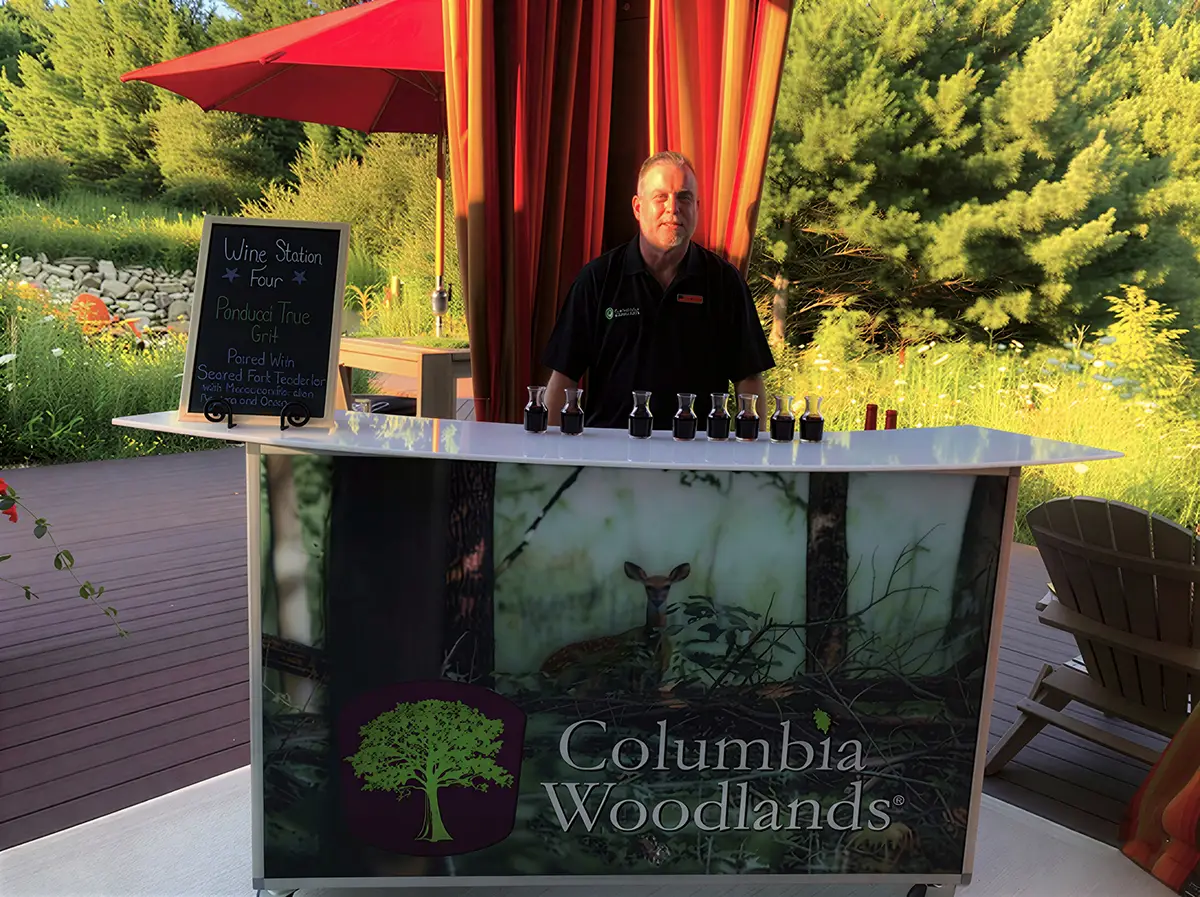
From Portland breweries to Willamette Valley wineries to Cascade mountain lodges—Oregon’s event scene demands flexibility. Portable bars give you that mobility without triggering Mobile Food Unit regulations, OHA plan reviews, or commissary contracts. Set up anywhere: forest clearings, historic barns, urban rooftops.
Skip MFU Compliance
Avoid $15k+ trailer build-outs and health department inspections
Access Any Location
Carry upstairs, into forests, across fields—trailers can’t go there
Official Oregon Resources
Legal References & Downloads
Full Legal Citations
Sale Definition (ORS 471.406)
ORS 471.406 defines “sale” as any exchange of consideration for alcohol. In Dry Hire, the bartender does not exchange consideration for alcohol—the host provides it freely to guests.
Service Permit Requirement (2025 Change)
“Every individual involved in the service or sale of alcohol must hold a Service Permit. New Legislation (2025): The ‘grace period’ that allowed new hires to work for 45 days while their application was pending has been eliminated. Staff must be fully certified before their first shift.”
Unlicensed Sale Prohibition
ORS 471.405 prohibits the sale of alcohol without a license. Purchasing alcohol with intent to resell (even at cost to a client) requires licensing.
Dram Shop Liability
“Oregon’s ‘Dram Shop’ law (ORS 471.565) allows injured third parties to sue alcohol servers and licensees if they serve a patron who is ‘visibly intoxicated’ and that patron subsequently causes injury.”
CAMP System Lead Time
“The digital CAMP infrastructure enforces hard stops on non-compliant applications. The administrative lead time for obtaining a TSL is rigidly enforced by software logic, making spontaneous event bookings legally impossible if the requisite 2-to-4-week window is missed.”
Mandatory Food Service
“For F-CAT licensees catering an event, or TSL holders, there must be at least two different substantial food items available at all times alcohol is served. ‘Substantial’ means a ‘meal,’ defined as a main course portion.”
Mobile Food Unit Requirements
“OHA regulations define ‘food’ to include ice and beverages. A mobile unit that dispenses cocktails or draft beer is legally classified as a Mobile Food Unit. Operators must adhere to OAR 333-162, which dictates integral freshwater and wastewater tanks, water heaters capable of delivering 100°F water for handwashing, and smooth, easily cleanable surfaces.”
Minor Mixing Prohibition
“The ‘Mixing’ Prohibition: A minor service permit holder may not mix drinks. They cannot combine a spirit with a mixer. They can pour wine or draw a beer from a tap, but the act of cocktail creation is reserved for those 21 and older.”
Stacking Prohibition
“OLCC rules prohibit serving a single patron more than two drinks at any one time. A bartender cannot sell a ‘bucket’ of 5 beers to one person. They cannot serve a ‘double-fisted’ order of a shot, a beer, and a cocktail (3 drinks) to a single guest.”
Cannabis Prohibition on Liquor Premises
“Despite the legality of recreational cannabis, the OLCC strictly prohibits the consumption of cannabis on a licensed liquor premises. A mobile bar operator cannot allow guests to smoke or consume cannabis within the ‘red line’ area of their alcohol service. Furthermore, infusing alcohol with cannabis (e.g., ‘Weed Vodka’) is strictly prohibited for liquor licensees.”
⚠️ Critical: Even though Oregon has legalized recreational cannabis, the two regulatory frameworks are kept intentionally separate. You cannot operate a combined alcohol/cannabis service under a liquor license.