







New Jersey Mobile Bartending Laws
New Jersey enforces strict “fixed premise” licensing and Home Rule authority, making mobile alcohol sales illegal without a brick-and-mortar license. Operators must choose Dry Hire service or partner with licensed caterers.
Current as of February 2026
Select Your Business Model
Dry Hire: Service-Only Model
The Dry Hire model is the only viable option for independent mobile bartending companies without a brick-and-mortar Plenary Retail Consumption License:
“A plenary retail consumption license shall be issued for use in connection with hotels, restaurants, clubs or other similar establishments.”
N.J.S.A. 33:1-12 Plenary Retail Consumption License. You operate as an equipment rental and staffing service, never taking title to the alcohol.
What You Provide:
- Equipment: The mobile bar unit, glassware, ice chests, bar tools
- Labor: Professional bartenders and bar backs
- Non-Alcoholic Supplies: Ice, sodas, mixers, garnishes, syrups
- Setup & Breakdown: Full service from arrival to departure
What the Client Provides:
- ALL Alcohol: Must be purchased from a Licensed NJ Retailer Required:
“No person shall… sell… any alcoholic beverages… unless licensed so to do.”
N.J.S.A. 33:1-43 licensed New Jersey liquor store - Ownership: The host owns the alcohol, you simply pour it as their agent
- Responsibility: Any leftover alcohol belongs to the client
Critical Rule: Private Events Only
Dry Hire is strictly limited to private, invitation-only events (weddings, corporate parties, backyard gatherings). Public Events Require Permits:
“No person shall sell any alcoholic beverage… without first having obtained a license therefor.”
N.J.S.A. 33:1-1 The moment an event is open to the public or tickets are sold for alcohol access, it becomes a retail sale requiring a permit.
Prohibited Activities:
- ❌ No “cash bar” collections—you cannot sell drinks
- ❌ No purchasing alcohol and billing it back to the client
- ❌ No “cup fees” where you give away alcohol but charge for the cup
- ❌ No public festivals, street fairs, or ticketed events without a licensed partner
Wet Hire: Licensed Catering Model
The Wet Hire model allows you to actually sell alcohol at events, but it is restricted to businesses that already hold a Catering Permit Eligibility:
“The holder of a plenary retail consumption license may apply for a catering permit to extend privileges to an off-premise location.”
N.J.A.C. 13:2 Plenary Retail Consumption License (License Code 33). Independent mobile bars cannot operate Wet Hire unless partnered with a licensed restaurant or bar.
The Catering Permit
The Catering Permit allows a plenary retail licensee to extend their privileges to an off-premise location for a single event. Catering Permit Fee:
“Application fee: $100 per 24-hour period.”
N.J. ABC Fee Schedule
Application Requirements:
- ✓ Must be filed via the POSSE System:
“All license and permit transactions must be processed through the POSSE Online Licensing System.”
ABC Bulletin 2015 POSSE Online System - ✓ Sketch of the event premises showing bar location
- ✓ Written permission from the property owner
- ✓ Security plan for events over 200 guests
- ✓ Payment of $100 per 24-hour period
Critical Restrictions:
- Food Service Required: Food Service Requirement:
“Catering permits are typically issued for events where food is also served. The ABC generally views alcohol-only events with skepticism.”
ABC Policy Guidance Catering permits generally require food service alongside alcohol. - Single Event Only: Each permit is for “single, special, non-recurring purposes”—not permanent operations.
- No Recurring Business: Prohibition on Permanent Operations:
“The Division will not issue a permit if it creates the impression to the general public that the permitted premises may be licensed.”
N.J.S.A. 33:1-74 You cannot get weekly permits for the same location, as that circumvents municipal license caps.
⚠️ The Social Affair Permit Alternative
Non-profit organizations can obtain Social Affair Permit:
“Permits for civic, religious, educational, charitable organizations. Cost: $100/day (civic/religious/educational) or $150/day (other nonprofits).”
N.J.A.C. 13:2-5.6 Social Affair Permits to sell alcohol at fundraisers and events. In this scenario, the non-profit holds the permit and buys the alcohol—you provide the service and equipment as a vendor. Limited to 12 permits per organization per year.
Common Regulatory Traps in New Jersey
The “Cup Fee” Myth
It is illegal for unlicensed operators to sell a plastic cup or mixer while “giving away” the alcohol. Prohibition on Indirect Sales:
“Any giving of alcoholic beverages that involves consideration is considered a sale under Title 33.”
N.J.S.A. 33:1-1 Both the ABC and local police view this as unlicensed alcohol sales—a disorderly persons offense subject to criminal prosecution.
Dry Town Danger
New Jersey has numerous “dry towns” where retail alcohol sales are prohibited. Ocean City Example:
“Prohibits all retail sales. BYOB in restaurants is banned. Public consumption is aggressively policed.”
Municipal Ordinance Operating in towns like Ocean City, Wildwood Crest, or Collingswood requires extreme caution. Even private events must remain strictly within residential confines, as police may use noise ordinances to police alcohol consumption.
Health Code Compliance
Mobile bars handling ice, garnishes, and beverages are classified as Mobile Retail Food Establishment:
“Any movable unit in which food or beverage is transported, stored, or prepared for retail sale.”
N.J.A.C. 8:24 “Mobile Retail Food Establishments” under N.J.A.C. 8:24. You must have a dedicated handwashing sink with hot/cold water (90-110°F), potable water tank, and wastewater tank at least 15% larger than your water supply. Failure to comply can result in immediate shutdown by municipal health inspectors.
Navigating New Jersey’s Dry Towns
New Jersey’s “Home Rule” doctrine has preserved a complex patchwork of municipalities where retail alcohol sales are restricted or prohibited. Municipal Home Rule:
“The governing body of each municipality serves as the issuing authority for retail licenses and can impose restrictions more stringent than state law.”
N.J.S.A. 33:1-40 Understanding these geographic restrictions is critical to avoiding criminal charges for unlicensed sales.
High-Risk Municipalities: Strictly Dry
Cape May County
- Ocean City: Ocean City Status:
“Prohibits all retail sales. Public consumption aggressively policed. ‘America’s Greatest Family Resort’ identity tied to alcohol ban.”
Municipal Code Strictly dry, public consumption banned - Wildwood Crest: Dry, referendums to overturn have failed
- Cape May Point: Strict prohibition on all sales
Camden County
- Collingswood: Collingswood “Moist” Status:
“No retail licenses for bars, but thriving BYOB restaurant scene. Breweries permitted. Dry Hire generally accepted at private venues.”
Municipal Code Dry (retail), but strong BYOB culture - Haddonfield: Dry (retail), hosts winery tasting room
- Haddon Heights: Recently transitioned from 120-year dry ban
Monmouth County
- Ocean Grove: Historical Methodist retreat, strict temperance
Somerset County
- Far Hills: Mostly dry, special permits for Race Meeting
Bergen County
- Saddle River: Dry status maintained
Operating Safely in Dry Towns
For Dry Hire operators, working in a dry town is theoretically legal if the event is strictly private (backyard wedding, residential party). The prohibition is on the sale of alcohol, not consumption on private property.
- ✓ Keep events invitation-only and on private residential property
- ✓ Avoid community centers, parks, or municipal facilities—they will ban alcohol
- ✓ Be vigilant about noise ordinances, as police may use them as enforcement tools
- ✓ Never advertise publicly that you’re serving alcohol in a dry town
Age Requirements & Staffing
Social Host Liability
New Jersey imposes Social Host Liability:
“A host who provides alcohol to a guest can be held liable for damages if the guest was visibly intoxicated when served.”
Case Law Precedent Social Host Liability, meaning hosts can be sued for serving visibly intoxicated guests. As a professional bartender, you can be held negligent if you serve someone who is clearly intoxicated, even in a Dry Hire scenario where you don’t own the alcohol. You need Liquor Liability or Professional Server Liability insurance.
Common Questions
Dry Hire
Do I need a liquor license for Dry Hire in NJ? ▼
No. As long as you are not selling alcohol, you are considered a service provider rather than a retailer. Because the client provides the alcohol, you do not need a state liquor permit.
Can I buy alcohol and bill the client back? ▼
No. Purchasing alcohol with the intent to resell it (even at cost) is illegal without a license. The invoice for alcohol must go directly to the client from the liquor store.
Can I operate a cash bar at a private wedding? ▼
Not in Dry Hire. A cash bar means you are selling alcohol, which requires a license. If you want a cash bar, you need a Catering Permit (Wet Hire) or the event host needs a Social Affair Permit.
Can I charge a “cup fee” and give away alcohol? ▼
No. This is viewed as the unlicensed sale of alcohol and is a criminal offense. The ABC and local law enforcement will prosecute this as a disorderly persons offense.
Can I transport alcohol for the client? ▼
It is not recommended. To avoid any risk of being classified as an unlicensed distributor, the client should transport their own alcohol to the venue.
Wet Hire & Permits
What is the POSSE system? ▼
The POSSE Online Licensing System is New Jersey’s mandatory digital portal for all alcohol license and permit applications, renewals, and transactions. All licensees and permittees must use it.
Can I get a Social Affair Permit as an individual? ▼
No. Social Affair Permits are only available to non-profit organizations (civic, religious, educational, charitable). Private individuals cannot get them for weddings or birthday parties.
Can non-profits use mobile bartenders? ▼
Yes. Non-profits obtain Social Affair Permits ($100-150/day), purchase the alcohol, and hire you to provide service and equipment. Organizations are limited to 12 permits per year.
How many Social Affair Permits can one location host? ▼
A specific venue location is limited to hosting 25 Social Affair Permit events per year. This prevents non-profits from effectively operating a permanent bar without a license.
Can club licenses do off-premise catering? ▼
No. Club licenses (License Code 31) such as VFWs, American Legions, and Elks Lodges are strictly for members and their bona fide guests. They do not have off-premise catering privileges.
Age & Staffing
How old do bartenders need to be in NJ? ▼
18 years old minimum. You must be 18 to sell or serve alcoholic beverages in New Jersey.
Can I hire a 17-year-old to pour wine? ▼
No. They must be 18 to serve alcohol. Minors under 18 can work as support staff (bussers, stock clerks) but absolutely cannot handle or pour alcohol.
What happens if I serve a visibly drunk person? ▼
You can be sued for negligence under New Jersey’s Social Host Liability laws, even in a Dry Hire scenario. Professional bartenders are expected to recognize intoxication and cut people off.
Health Code & Equipment
Do I need a commissary in New Jersey? ▼
Yes, if you operate a mobile trailer or truck. It must be stored and serviced at a licensed commissary or base of operations, not at a private residence. Health inspectors will require proof.
Does my mobile bar need a handwashing sink? ▼
Yes. Any mobile unit handling beverages, ice, or garnishes requires a dedicated handwashing sink with hot and cold running water capable of reaching 90-110°F under N.J.A.C. 8:24.
What is the wastewater tank requirement? ▼
Your wastewater (gray water) tank must be at least 15% larger than your potable water supply tank to prevent overflow during operation. Dumping gray water into storm drains is illegal.
Dry Towns & Geography
Can I operate in Ocean City, NJ? ▼
With extreme caution. Ocean City is strictly dry and aggressively polices alcohol. Dry Hire is legal for private events on private property only. Avoid public venues and keep noise levels down.
What’s the difference between dry and moist towns? ▼
Dry towns prohibit all retail alcohol sales (no bars, no liquor stores). “Moist” towns like Collingswood don’t issue retail licenses but allow BYOB in restaurants and may permit breweries.
Insurance & Liability
What insurance do I need for mobile bartending in NJ? ▼
You need General Liability insurance for property damage and injury, plus Liquor Liability (Wet Hire) or Professional Server Liability (Dry Hire) to cover alcohol-related claims and Social Host Liability exposure.
Miscellaneous
What are NJ’s hours of operation for alcohol? ▼
Package sales (liquor stores): 9 AM to 10 PM statewide. On-premise consumption hours are set by municipal ordinance, typically with closing times between 1 AM and 3 AM.
Can I advertise BYOB services in New Jersey? ▼
Be cautious. While BYOB is allowed, advertising “Bring Your Own Bottle” in the same manner as licensed restaurants can be viewed as a disorderly persons offense. Avoid explicit BYOB marketing language.
Capitalize on the Garden State Market
From Atlantic City boardwalk weddings to Princeton estate celebrations, New Jersey events demand sophistication and strict regulatory compliance. With Home Rule creating 565 different municipal jurisdictions, portable bars offer flexibility that trailers cannot match—bypassing zoning restrictions, fitting through venue doorways, and avoiding the complex commissary requirements of mobile food establishments.
Dry Hire Ready
No commissary, no health inspection, no fixed premise issues.
Indoor Venue Access
Navigate Jersey Shore estates, Newark lofts, and Princeton country clubs.
Professional Presentation
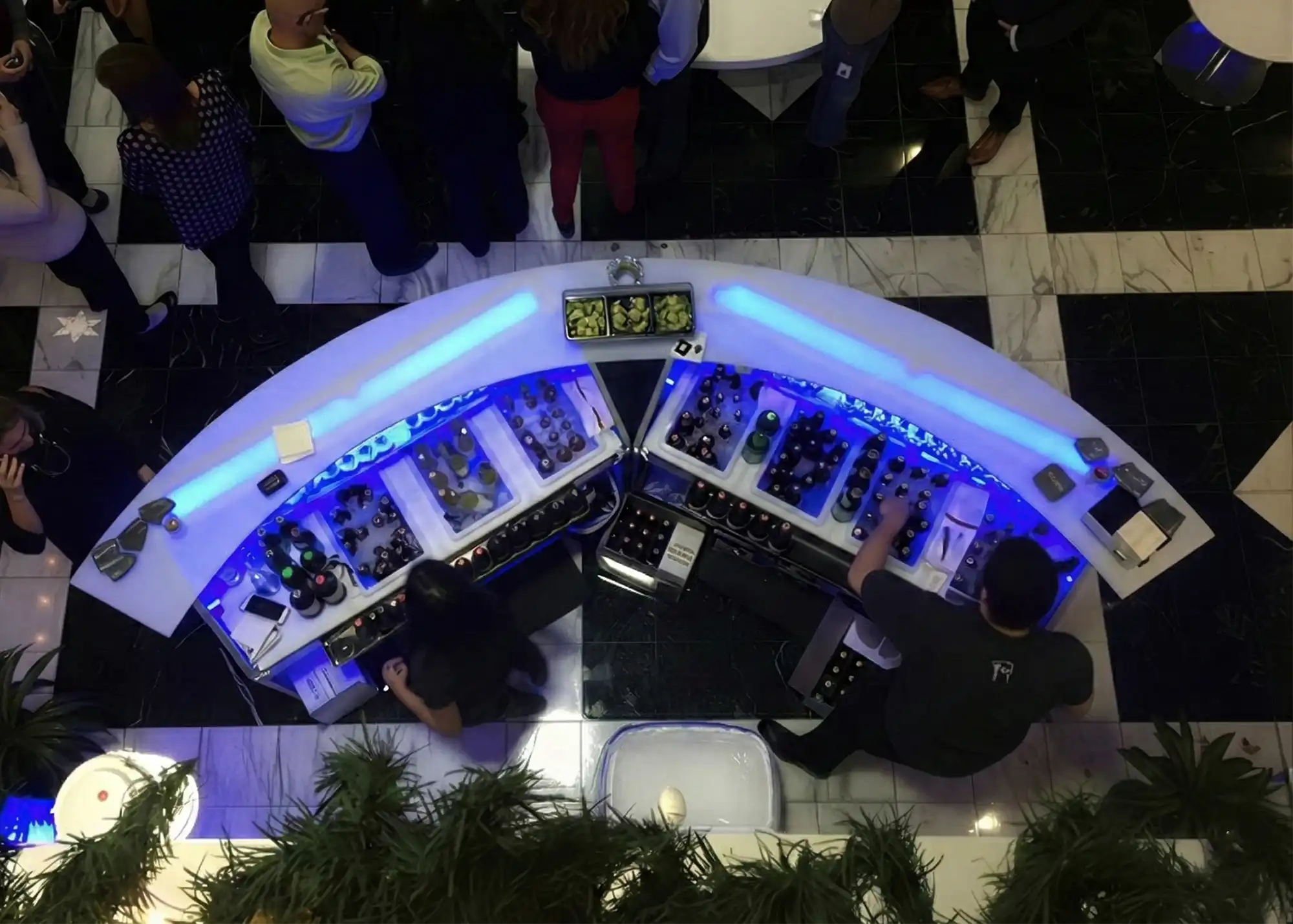
LED-illuminated elegance that matches NJ’s upscale event expectations.
Official New Jersey Resources
Legal References & Downloads
Full Legal Citations
Plenary Retail Consumption License Definition
“A plenary retail consumption license shall be issued for use in connection with hotels, restaurants, clubs or other similar establishments… for consumption on the licensed premises only.”
Prohibition on Unlicensed Sales
“No person shall, directly or indirectly, import, manufacture, sell, distribute, transport, or possess any alcoholic beverages for sale, distribution, or manufacture, unless licensed so to do under the provisions of this chapter.”
Public Sale Requires License
“No person shall manufacture, sell, or distribute any alcoholic beverage… without first having obtained a license therefor as in this chapter provided.”
Catering Permit Eligibility
“Only the holder of a plenary retail consumption license may apply for a catering permit to extend their licensed privileges to an off-premise location for a single event.”
Catering Permit Fee Schedule
“Catering Permit application fee: $100.00 per 24-hour period.”
POSSE Online System Requirement
“All license and permit transactions must be processed through the POSSE Online Licensing System. All licensees and permittees must create an account.”
Food Service Requirement for Catering
“Catering permits are typically issued for events where food is also served. The ABC generally views alcohol-only events with skepticism unless they are strictly controlled tastings.”
Prohibition on Permanent Off-Premise Operations
“Permits are for single, special, non-recurring purposes. The Division will not issue a permit if it creates the impression to the general public that the permitted premises may be licensed.”
Social Affair Permit for Non-Profits
“Social Affair Permits available for civic, religious, educational, charitable, fraternal, social, or recreational organizations. Cost: $100/day (civic/religious/educational) or $150/day (other nonprofits). Limited to 12 permits per organization per year.”
Broad Definition of “Sale”
“The statute defines a sale not just as the direct exchange of money for a beverage, but as any giving of alcoholic beverages that involves consideration.”
Ocean City Dry Town Status
“Ocean City prohibits all retail alcohol sales. BYOB in restaurants is banned. Public consumption is aggressively policed. The town’s ‘America’s Greatest Family Resort’ identity is tied to this ban.”
Mobile Retail Food Establishment Definition
“Mobile Retail Food Establishment means any movable restaurant, truck, van, trailer, cart, bicycle, watercraft, or other movable unit including hand carried, portable containers in or on which food or beverage is transported, stored, or prepared for retail sale or given away at temporary locations.”
Municipal Home Rule Doctrine
“The governing body of each municipality serves as the issuing authority for retail consumption and distribution licenses. Municipalities have discretion to impose restrictions more stringent than state law.”
Ocean City Strict Enforcement
“High Risk. Prohibits all retail sales. BYOB in restaurants is banned. Public consumption is aggressively policed. Even private events should remain strictly within residential confines. America’s Greatest Family Resort identity is tied to this ban.”
Collingswood “Moist” Town Status
“Moist Culture. No retail licenses for bars, but a thriving BYOB restaurant scene. Breweries permitted. Mobile bars (Dry Hire) generally accepted at private venues due to BYOB familiarity.”
Age 18 Service Requirement
“A person must be 18 years old to sell or serve alcoholic beverages.”
Minor Employment Restrictions
“Minors under 18 can be employed at a licensed premise (e.g., as a busboy, stock clerk) but cannot prepare, serve, or sell alcohol.”
TIPS/TAM Training Recommendation
“While not strictly mandatory for private party bartenders by statute, maintaining TIPS or TAM certification is the industry standard defense against negligence claims. It proves the bartender was trained to identify and cut off intoxicated patrons.”
Social Host Liability
“New Jersey law imposes Social Host Liability, meaning a host who provides alcohol to a guest can be held liable for damages caused by that guest if the guest was visibly intoxicated when served.”