






New Hampshire Mobile Bartending Laws
New Hampshire supports service-only dry hire, but selling or supplying alcohol requires NH Liquor Commission authority. Operators can pursue an annual off-site caterer license or, for a limited number of approved events, the newer one-day for-profit license.
Current as of July 2026. Reviewed against New Hampshire RSA Titles XIII and LXIII, NHLC licensing guidance, and NH DHHS food-protection materials.
New Hampshire Mobile Bartending: Key Facts
| Regulator | New Hampshire Liquor Commission (NHLC), Division of Enforcement & Licensing. |
| Mobile liquor license | No general roaming mobile-bar license. Wet hire uses an off-site caterer license or an approved one-day event license. |
| Dry hire | Generally workable for a private, invitation-only event when the host buys, owns, and provides the alcohol and the bartender charges only for labor, equipment, and nonalcoholic supplies. |
| Off-site caterer fee | $840 annually. |
| Caterer prerequisites | Food-based catering business; normally 50% of licensed sales must be food, with an exemption at $100,000 in annual food sales. A standalone off-site service needs a permanent nonresidential office with secure alcohol storage. |
| Event notice | Five days for a catered function; new premises or locations require NHLC approval at least 10 days before the event. |
| For-profit one-day license | $100; maximum 500 patrons and six licenses per entity per calendar year; application and local approvals are due at least 15 days before the event. |
| Minimum server age | 18 on licensed premises. |
| Bartender certification | No separate state bartender card. NHLC management training is mandatory for license representatives; employee T.E.A.M. training is strongly recommended. |
Choose Your Business Model
Dry Hire: Service Without the Alcohol Transaction
New Hampshire requires a license to sell or distribute alcohol by selling, transferring, giving, delivering, bartering, or exchanging it, directly or indirectly. A service-only bartender who never purchases, owns, supplies, reimburses, or sells the alcohol generally remains outside that retail transaction. This is a practical inference from the licensing statute—not a special “dry-hire permit.”RSA 178:1: Requires licensing for direct or indirect alcohol sales and distribution and classifies violations as class B felonies.
What Your Company Can Sell
- Bartending labor and barbacks
- Portable-bar and equipment rental
- Ice, mixers, syrups, garnishes, and zero-proof drinks
- Glassware, cups, napkins, and sanitation supplies
- Menu design, shopping quantities, setup, and cleanup
Keep Completely Outside Your Invoice
- Alcohol purchased by the bartending business
- Client reimbursement for alcohol
- Cash bars, per-drink sales, tickets, or alcohol-inclusive admission
- “Complimentary” alcohol tied to a paid package
- Taking ownership of leftover alcohol
Private Event Means Private
Keep the event invitation-only, document that the host purchased and owns the alcohol, and confirm that the venue permits outside alcohol and bartenders. If guests pay to enter or obtain drinks, the arrangement may become an indirect sale.
Responsible Service Still Applies
Do not serve anyone under 21 or anyone visibly intoxicated. New Hampshire also recognizes civil liability when alcohol is negligently served to a minor or intoxicated person.RSA 179:5 and RSA 507-F:4: Prohibit service to minors and visibly intoxicated persons and establish negligent-service liability.
Wet Hire: Annual Off-Site Caterer License
New Hampshire’s annual wet-hire path is the off-site caterer license. A qualifying licensee may serve liquor, beer, wine, and specialty beverages—with or without meals—to a private group that contracted for the service at an approved site. It is not an alcohol-only mobile-bar license.RSA 175:1 XIV-a–XV: Defines caterers and off-site catering services, including food and permanent-office requirements.
Annual License Fee
Food-Sales Standard
Food-Sales Exemption
At least half of sales under a caterer’s license normally must be food. A caterer with $100,000 or more in annual food sales is exempt from the percentage test. An independent off-site catering service must also maintain a permanent nonresidential business office with secure beverage and liquor storage. With NHLC approval, a service without its own kitchen may subcontract food preparation.RSA 175:1 and RSA 178:22: Establish food-sales, office, storage, and subcontracting provisions.
Private Residences Are Excluded
An off-site caterer may work at another licensed establishment or an approved “public building.” For this statute, public building can include closed retail locations, separated licensed premises, tents, gazebos, and defined outdoor areas with two nearby toilets—but it expressly does not include a private residence.
Event Approval Timeline
- Notify NHLC at least five days before each catered function, with its date, time, and location.
- Obtain approval for a new premises or location at least 10 days before the event.
- Use Form L-038 for temporary or permanent off-site-caterer site approval and complete any requested inspection or local documentation.
- File the annual food-and-alcohol sales certificate between January 15 and February 15.
The current annual fee is $840.RSA 178:22 and RSA 178:29: Establish the five-day notice, 10-day site approval, annual reporting, and $840 fee.
Dry Counties and Local Option
New Hampshire does not regulate alcohol through county liquor boards or a simple dry-county list. Cities and towns vote separately on state stores, beer sales, table-wine sales, and on-premises liquor sales. A municipality can therefore allow some categories and reject others.RSA 663:5: Establishes municipal ballot questions and the effect of local votes on licensing.
Booking rule: Verify the exact town, license category, premises approval, fire/assembly status, and outdoor-area rules before accepting wet-hire work. NHLC materials have historically identified Ellsworth as a dry town, but local-option status should be reconfirmed directly with NHLC for every current booking.
One-Day Event License: A Limited Third Path
Effective September 30, 2025, NHLC may issue a limited one-day license to an approved responsible individual representing a for-profit group or organization. The license authorizes alcohol sales at one Commission-approved premises without requiring an annual off-site caterer license.RSA 178:22 V(l-a): Creates one-day licenses for approved for-profit organizations.
License Fee
Maximum Patrons
For-Profit Limit
Application Lead Time
Application Package
- NHLC approval of the applicant and exact event premises
- Official approval from the local fire chief
- Official approval from the local health department
- Official approval from the local police chief
- Application filed at least 15 days before the event
- Management representative completes NHLC training before the license takes effect
The statutory fee for a one-day license is $100. Voluntary nonprofit organizations use a parallel one-day route but are not subject to the for-profit 500-person and six-license limits stated in subsection (l-a).RSA 178:29 and RSA 178:2: Set the $100 fee and require training before a one-day license becomes effective.
Confirm the Current Application Process
The for-profit route is new, and public NHLC form pages may lag statutory changes. Contact Licensing at (603) 271-3523 or licensing@liquor.nh.gov before advertising alcohol-inclusive packages or accepting payment for alcohol.
Common New Hampshire Compliance Traps
Buying Alcohol for Reimbursement
That is not dry hire. New Hampshire’s statute reaches direct and indirect sales, transfers, gifts, and deliveries.
Treating the $840 License as Roaming Authority
Every function requires advance notice, and new sites need separate approval. The license does not authorize service anywhere on demand.
Wet Hire at a Private Residence
The off-site caterer statute’s approved “public building” definition expressly excludes private residences.
Ignoring the Food Requirement
An alcohol-only mobile bar does not satisfy the caterer definition. Build a genuine food operation or obtain NHLC approval to subcontract food services.
Promoting Free Drinks
Retail licensees may not give away free drinks except through specifically authorized tasting provisions.RSA 179:44: Prohibits licensees from giving away free drinks and lists limited tasting exceptions.
Building a Trailer Before Health Review
If the trailer qualifies as a mobile food unit, DHHS plan review, sinks, licensing, and a servicing-area plan may apply. Confirm before construction.
Do New Hampshire Bartenders Need a License?
There is no separate statewide occupational bartender license or card.
The mandatory credential belongs to the alcohol business or event. A representative of a new retail licensee must complete NHLC’s Management Training Seminar within 45 days of license issuance. A management representative for a one-day license must complete the applicable training before the event.RSA 178:2: Establishes required licensee and one-day-license management training.
M.T.S.—Required for Management
Covers state law, licensing, responsible practices, civil liability, IDs, intoxication, and orderly-premises management.
T.E.A.M.—Recommended for Servers
NHLC’s employee course covers IDs, visible intoxication, intervention, responsible service, and civil-liability risk.
Dry-hire best practice: Even when no retail license is involved, complete T.E.A.M. or another recognized responsible-service course and maintain written house policies.
How to Start a Mobile Bartending Business in New Hampshire
Choose the Operating Model
Start with service-only dry hire, build a qualifying annual catering business, or use the one-day path only for occasional approved events.
Register the Business
Form the entity through the New Hampshire Secretary of State, register any trade name, obtain an EIN, and set up applicable tax accounts. A New Hampshire LLC certificate of formation is $100, plus the online handling charge when filed electronically.NH Secretary of State: Form LLC-1 lists a $100 formation fee.
Handle Food and Tax Licensing
If selling catered food or taxable meals, determine whether DHHS food-establishment licensing and a Department of Revenue Administration Meals & Rentals Tax Operator’s License apply.
Complete Training and Written Policies
Schedule mandatory M.T.S. or one-day training where applicable, put servers through T.E.A.M., and document ID checks, intoxication cutoffs, incident reporting, and transportation procedures.
Secure Insurance
Discuss general liability, liquor liability or host-liquor exposure, commercial auto, equipment, and event coverage with a New Hampshire-licensed professional. Employers with any full- or part-time employee generally must carry workers’ compensation.NH Department of Labor: Employers with employees generally must provide workers’ compensation coverage.
Use an Event Approval Checklist
Confirm who owns and sells the alcohol, the license and approved area, municipal local-option status, NHLC notice dates, fire/health/police approvals, service hours, staffing ages, food plan, and insurance certificates.
Folding Bar vs. Converted Trailer
A folding portable bar used inside an existing approved venue is equipment. A trailer that qualifies as a mobile food unit may trigger DHHS food licensing and plan review. DHHS guidance calls for at least a hand sink on the unit and access to a three-bay sink on board or at a servicing area; converted vehicles require plan review before construction. New food-establishment plan review carries a $75 fee.NH DHHS: Mobile Food Unit FAQ and floor-plan materials describe sinks, servicing areas, preconstruction review, and the $75 fee.
Whether a beverage-only unit falls within a particular food-license category depends on the menu, preparation, location, and local self-inspection rules. Confirm directly with NH DHHS Food Protection before building or operating a trailer.
Age, Staffing, and Service Hours
Serve and Bartend
On-premises licensees may employ people age 18 or older as waitstaff, bartenders, or hosts who serve or handle alcohol.
Limited Support Work
Minors age 14 or older may clean tables, remove empties and glasses, and assist with stocking—but may not serve or otherwise handle alcohol.
License Applicant
The proposed licensee and controlling applicants must be at least 21, even though an employee may bartend at 18.
A person at least 18 must be present and designated in charge of the employees and business whenever licensed alcohol service is operating.RSA 179:23 and RSA 178:3: Establish server, support-worker, person-in-charge, and applicant ages.
Sales and Consumption Hours
On-premises licensees generally may sell from 6:00 a.m. to 1:00 a.m., seven days a week. A city or town may authorize sales until 2:00 a.m. by ordinance. Drinks must be consumed no later than 30 minutes after the serving hour expires.RSA 179:17: Establishes general on-premises sales hours, local 2:00 a.m. authority, and the 30-minute consumption window.
Common Questions & “Loophole” Myths
Dry Hire
Can I run a dry-hire mobile bar in New Hampshire?▼
Generally yes for a genuinely private event when the host purchases, owns, and provides all alcohol and your business charges only for services, equipment, and nonalcoholic supplies. This is an inference from the licensing statute, not a dedicated dry-hire permit.
Can I purchase alcohol and bill the host back?▼
No—not as dry hire. Reimbursement, bundled pricing, drink tickets, and alcohol-inclusive admission can create a direct or indirect alcohol sale.
Does a portable bar or trailer create a liquor license?▼
No. Equipment does not create alcohol-sale authority. A converted trailer may also require food-unit review depending on its operation.
Licensed Alcohol Service
What does the off-site caterer license cost?▼
The annual statutory fee is $840, plus any applicable application, business, food, tax, inspection, and local costs.
Can an off-site caterer serve at a private home?▼
Not under the ordinary off-site caterer provision. Its eligible “public building” definition expressly excludes a private residence.
Does New Hampshire have a for-profit one-day license?▼
Yes. The newer license costs $100, is limited to 500 patrons, and is capped at six licenses per for-profit entity per year. Apply with local approvals at least 15 days ahead.
Can a licensed caterer give away complimentary drinks?▼
A retail licensee generally may not give away free drinks. Narrow tasting rules are separate and require compliance with NHLC conditions.
Credentials and Local Rules
Do bartenders need a state card?▼
No separate statewide bartender card is required. License owners or designated managers have mandatory training, and NHLC offers voluntary T.E.A.M. training for employees.
How old must a bartender be?▼
At least 18 to serve or otherwise handle alcohol as a bartender on licensed premises.
Are there dry counties in New Hampshire?▼
New Hampshire uses municipal local-option votes rather than county liquor boards. Verify beer, wine, on-premises liquor, and social-district authority for the exact city or town.
How late can a licensed event serve?▼
Generally until 1:00 a.m.; a municipality may authorize 2:00 a.m. sales. All drinks must be consumed within 30 minutes after service ends, and an event approval can set narrower hours.
Equipment and Consumables a Mobile Bar Actually Uses
“What do I need to bring to every event?”
Whether you operate dry hire, work under an off-site caterer license, or staff a one-day event, your equipment list is largely the same. New Hampshire venues expect a professional, sanitary setup that stays within the approved service area.
Core Equipment (Reusable)
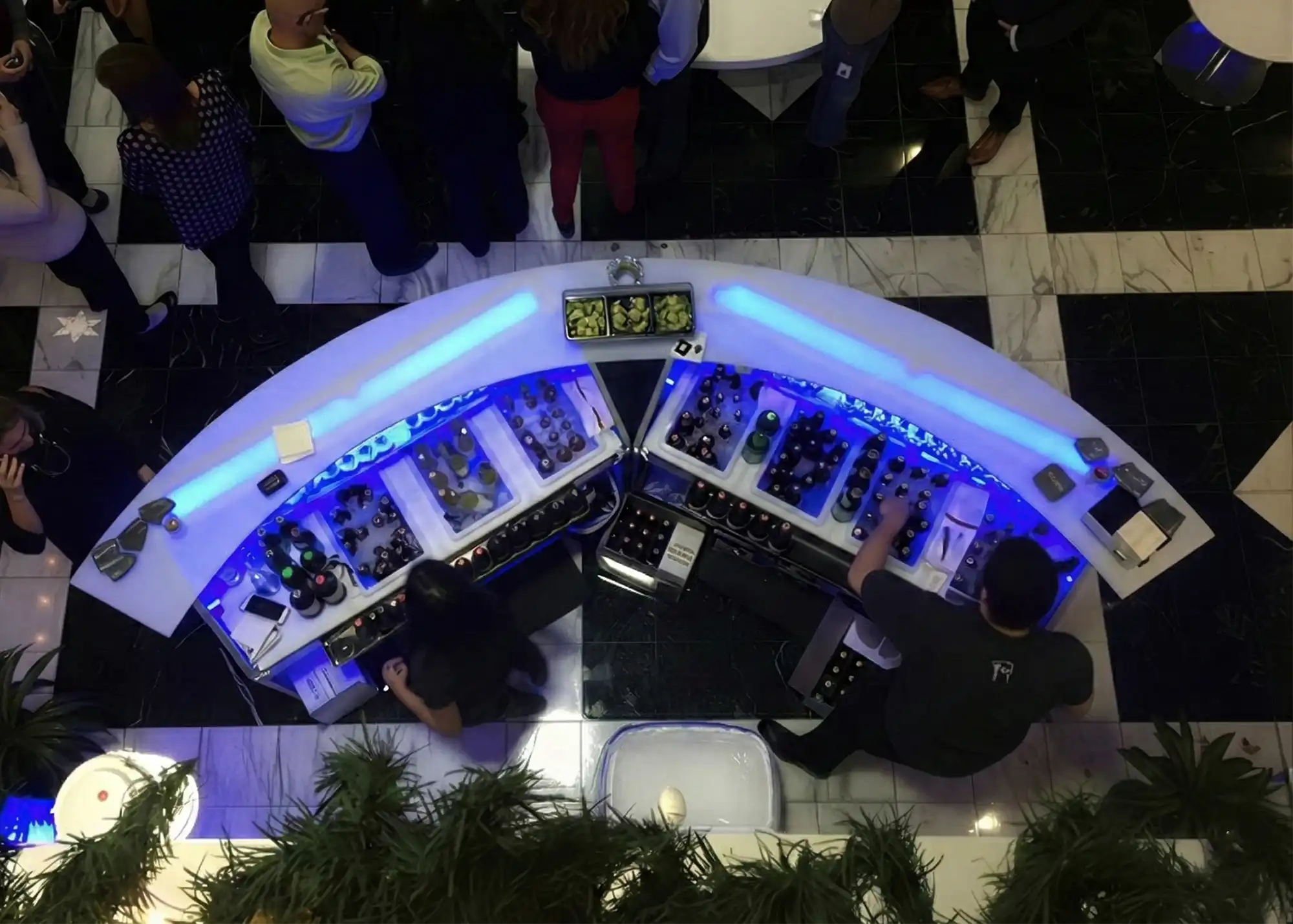
- A portable bar with a food-safe work surface. A 48-inch folding bar fits in an SUV, while a 62-inch LED bar or 77-inch bar handles larger weddings.
- Ice bins with drains. A built-in ice bin keeps ice protected and the service area dry.
- Speed rails and bottle wells for working bottles.
- Bar tools: shakers, strainers, jiggers, muddler, wine key, bar spoons, cutting board, and knife.
- Back bar and transport: a folding back bar and transport case.
- Sanitation: bar towels, sanitizer, handwashing supplies, gloves, trash, and recycling containers.
Consumables (Restocked Every Event)
- Ice: roughly 1 to 1.5 pounds per guest for a full bar.
- Cups or glassware, napkins, and coasters.
- Mixers: sodas, tonic, juices, syrups, sour mix, and bitters.
- Garnishes: citrus, cherries, olives, and fresh herbs.
- Straws, picks, stirrers, and beverage napkins.
- Water station supplies for responsible service.
- CO2 or nitrogen for draft systems or approved batched beverages.
Dry-hire tip: provide the complete equipment and mixer package while the client purchases only the alcohol. Keep the alcohol purchase completely outside your invoice.
Your License May Be Tied to an Approved Site. Your Bar Does Not Have to Be.
From Manchester weddings to Concord corporate events and Lakes Region receptions, a clean professional setup helps venues and investigators trust your operation. PortableBar.com has manufactured commercial-grade portable bars in the USA since 2004.
Starting Out: 48-inch Folding Bar
Fits in an SUV and sets up in minutes—ideal for dry-hire startups.
Weddings & Events: 62-inch LED Bar
Built-in ice-bin options and a polished front presentation.
High Volume: 77-inch Bar
Enough room for two bartenders and larger guest counts.
USA-made equipment since 2004
Official New Hampshire Resources
Legal Citations and Source Notes
Legal disclaimer: This page provides general educational information, not legal advice. Alcohol laws, fees, forms, and agency interpretations change. Confirm every event with NHLC, the municipality, the venue, NH DHHS when applicable, and qualified legal and insurance professionals before operating.