






Michigan Mobile Bartending Laws
Michigan does not issue standalone licenses for mobile bars. You either operate as an unlicensed service provider (Dry Hire) or as an extension of a brick-and-mortar restaurant (Wet Hire).
Current as of February 2026
Select Your Business Model
Short Answer: You do NOT need a liquor license. In fact, the MLCC states “There is no license for mobile bars” for private events. You operate under the Private Event Exemption.
The “Private Event” Exemption
Michigan allows unlicensed service at events that meet strict criteria. If you follow these rules, the MLCC considers the event “private” and outside their jurisdiction for sales. [Ref] No License Exists:
“There is no license for mobile bars or mobile bartending services for private events in Michigan.”
Source: MLCC FAQs
The Three Golden Rules:
1. By Invitation Only: No public advertising, no walk-ins.
2. No Charges: No cash bar, no ticket sales, no “donations” for drinks.
3. Host Supply: The host (client) must purchase the alcohol.
The Procurement Wall
Zero Ownership: The Dry Hire operator must never take title to the alcohol. If you buy a bottle of vodka with your own money and ask the client to pay you back, you are acting as an unlicensed wholesaler. [Ref] Felony Risk:
“If a Dry Hire operator purchases alcohol… they have acted as an unlicensed wholesaler or retailer, committing a felony under the Code.”
Source: Michigan Liquor Control Code
Service Only: Your invoice can only cover “Equipment Rental,” “Staffing,” and “Consumables” (mixers/garnishes). The alcohol transaction must be strictly between the host and the store.
Short Answer: To sell alcohol, you must hold a Catering Permit. This permit acts as an extension of an existing “brick-and-mortar” license (like a Class C or Tavern license). You cannot be a standalone mobile bar.
The “Brick-and-Mortar” Tether
Michigan law does not allow “virtual” liquor licenses. To get a Catering Permit ($100/yr), you must already hold a specific retailer license (Class C, Tavern, SDD, etc.) AND a Food Service Establishment license. [Ref] Prerequisite:
“Applicant must hold a… retail liquor license and a Food Service Establishment License… effectively eliminating ‘virtual’ mobile bars.”
Source: MCL 436.1547
The Reality: Wet Hire in Michigan is typically performed by established restaurants or caterers who have a commercial kitchen and liquor license, using a mobile bar as their “off-site” vehicle.
💰 1st Year Investment Breakdown
- Underlying Liquor License (Class C) $10,000+*
- Catering Permit (Annual) $100
- Inspection Fee $70
- Food License (STFU) & Review ~$300
- Total Est. Regulatory Cost $10,470+
*Class C licenses in Michigan are quota-based. Prices vary wildly by county and market availability.
Control State Purchasing (SIPS+)
Since Michigan is a Control State, all spirits served under your Catering Permit must be purchased from the state via the SIPS+ system. [Ref] SIPS+ System:
“Wet Hire operators… utilize SIPS+ to purchase inventory from the state… ensuring all spirits served have been legally acquired.”
Source: MLCC Financial Management
⚠️ Reality Check: The “STFU” Trap
In Michigan, the Liquor Code is only half the battle. The **Food Law** determines your equipment legality.
1. Ice is Food
Michigan Food Law explicitly defines ice as “food” and cutting fruit as “food preparation.” If you scoop ice or slice a lime, you are a Food Establishment. [Ref] Jurisdictional Hook:
“A fundamental premise of Michigan food law is that ice is defined as food… washing and cutting fruit is explicitly defined as food preparation.”
Source: MI Food Law of 2000
2. The STFU License
Trailers are classified as Special Transitory Food Units (STFU). To operate legally, a trailer needs an STFU license from a Local Health Dept, a Plan Review ($197+), and a Commissary agreement.
Impact: Trailers are heavily regulated.
3. The 4-Day Notice
STFU operators must submit a “Notice of Intent” to the local health department 4 days before serving in a new jurisdiction. Failure to do so can result in shut-down.
Action: Paperwork required for every gig.
Staffing & Operations Matrix
Michigan rules on who can serve alcohol at private events.
| Role | Minimum Age | The Rule |
|---|---|---|
| Standard Server | 18+ | General rule: Person must be 18 to sell or serve alcohol. [Ref] Age to Serve: “The general rule in Michigan is that a person must be 18 years old to sell or serve alcoholic liquor.” Source: MCL 436.1707 |
| 17-Year-Old Exception | 17 | Allowed IF they have completed server training AND are supervised by an 18+ trained person on-site. |
| Server Training | Mandatory (Wet) | Mandatory for Catering Permit staff. “Any employee… that will deliver and serve… at a private event.” |
| Background Checks | Licensee Only | Mandatory for the License Holder (Owner) during application. Not strictly required for servers unless company policy dictates. |
Common Questions
Private Events & Operations
Can a “private” corporate event have 500 people? ▼
YES. In Michigan, the distinction is about control, not size. A “Private Event” must be “by invitation only” and closed to the general public. A company holiday party with 500 badged employees is private; a public festival with 50 people is public. [Ref] Private Event Criteria:
“By Invitation Only… The event must be closed to the general public.”
Source: MLCC Private Event Guidelines
Why is Michigan so strict about the reimbursement rule? ▼
Control State Integrity. Buying alcohol and getting reimbursed makes you an unlicensed wholesaler/retailer. Michigan classifies unlicensed sales as a FELONY, not just a misdemeanor. [Ref] Felony Classification:
“If a Dry Hire operator purchases alcohol… they have acted as an unlicensed wholesaler… committing a felony.”
Source: MI Liquor Control Code
Can I at least go TO the store with the client and help them shop? ▼
YES. You can act as a consultant. You can meet them at the store, recommend quantities, and load their cart. But THEY must pay, receive the receipt, and take possession. You are advising, not transacting.
Can clients still have alcohol at a private wedding in a dry township? ▼
YES for Dry Hire. The “dry” designation prohibits sales. If the host provides the alcohol (Private Event Exemption), no sale occurs, so it is compliant. However, a Wet Hire operator (Catering Permit) CANNOT serve spirits in a dry township because their service constitutes a sale. [Ref] Local Option:
“A Catering Permit authorizes a sale… a Wet Hire operator cannot legally cater a private event involving spirits in a dry township.”
Source: MLCC Local Option Rules
Can I accept tips from wedding guests? ▼
YES. Tips are for your service/skill, not for selling alcohol. A clearly marked tip jar (“Gratuities for Bartending Service”) is fine. Avoid labeling it in a way that implies payment for the drink itself (e.g., “Donations”). [Ref] No Indirect Charges:
“There can be no… ‘Tip Jars’ that function as payment for alcohol access.”
Source: Private Event Rules
Licensing & Equipment (STFU)
What exactly is required to get a Catering Permit in Michigan? ▼
You must ALREADY hold: (1) An active retail liquor license (Class C, Tavern, SDD, SDM) at a brick-and-mortar location, and (2) A Food Service Establishment License. Only then can you apply for the Catering Permit ($100/year). [Ref] Prerequisites:
“Applicant must hold a specific type of retailer license and a Food Service Establishment License.”
Source: MCL 436.1547
What’s the difference between STFU regulations and regular food rules? ▼
STFUs (trailers) face ADDITIONAL rules: (1) 4-day advance notice to the local health department before serving in a new jurisdiction, (2) must have an approved commissary, (3) strict plan review required before operation. Regular restaurants do not need to notify the health department every time they serve. [Ref] Notice of Intent:
“An STFU operator must submit a ‘Notice of Intent to Operate’ form… at least 4 business days prior to the event.”
Source: MDARD STFU Guidelines
How do I avoid STFU classification if I want to serve drinks with ice? ▼
Use PORTABLE BAR EQUIPMENT inside the venue. Portable bars are generally classified as “service equipment” (like tables), not food establishments. Use pre-bagged ice and pre-cut garnishes (or prepare them in a licensed kitchen) to avoid the “food preparation” trigger that traps trailers.
What is the server training requirement for Catering Permit staff? ▼
Mandatory for “any employee that will deliver and serve at a private event” under a Catering Permit. This includes 17-year-old employees, who must also be supervised by trained 18+ staff. [Ref] Mandatory Training:
“Any employee of a licensee with a Catering Permit that will deliver and serve alcoholic beverages… must successfully complete a Commission-approved server training program.”
Source: MLCC Server Training Rules
Liability
Do I need insurance for mobile bartending in Michigan? ▼
ABSOLUTELY. For Wet Hire (Catering Permit), Liquor Liability Insurance is statutorily required. For Dry Hire, General Liability and Bartender Liability are essential because Michigan has “dram shop” laws—you can be sued for negligence if a guest you served causes an accident. [Ref] Proof of Financial Responsibility:
“All retail licensees, including Catering Permit holders, must maintain Liquor Liability Insurance (Form LC-95).”
Source: MCL 436.1803
Does insurance cover me if I violate Michigan laws? ▼
NO. Insurance policies typically exclude coverage for criminal or illegal acts. If you are caught illegally reselling alcohol (a felony) or operating without proper licenses, your insurance carrier will likely deny the claim, leaving you personally liable.
Capitalize on the Great Lakes
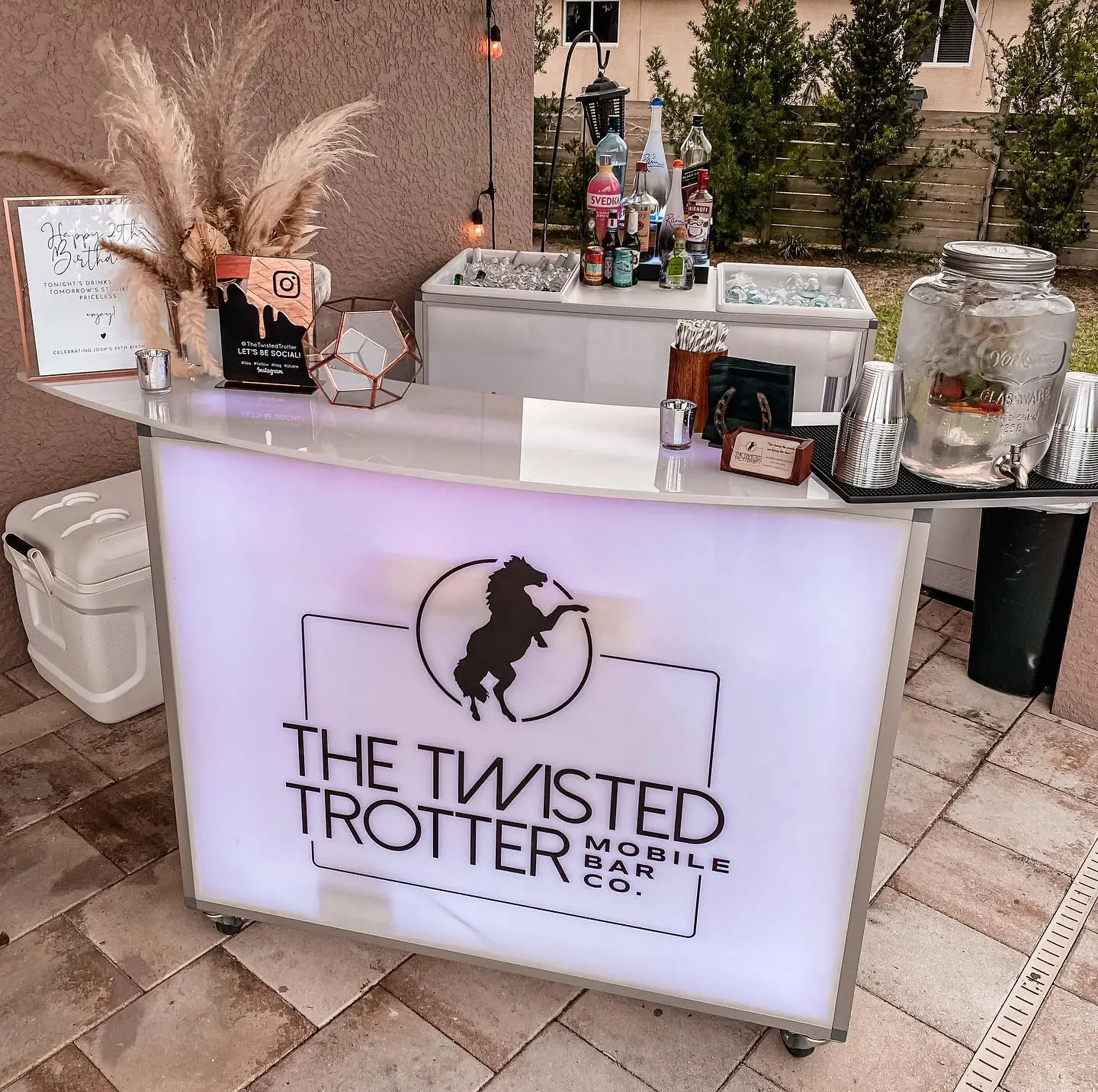
Michigan’s “Wedding Barn” industry is booming, but many venues lack licensed bars. This is where portable bars shine. Unlike trailers that get stuck in the “STFU” regulatory trap, our folding bars allow you to set up inside a barn or lakeside tent instantly, often bypassing complex vehicle inspections.
STFU Exempt?
Portable setups often avoid the heavy “Mobile Food Unit” regulations that hit trailers.
Indoor/Outdoor
Perfect for Michigan weather—move inside instantly if it rains.