




Oklahoma Mobile Bartending Laws
Oklahoma now has a refreshingly direct path for paid dry hire: a 21-or-older bartender can obtain an Event Bartender license and serve host-supplied alcohol at a qualifying event venue. Selling or supplying the alcohol is a different business model requiring a Caterer or event license—and ABLE draws a firm line against operating a bar from a trailer or vehicle.
Last reviewed: July 16, 2026 · Educational information, not legal advice
Oklahoma Mobile Bartending: Key Facts
| Regulator | Oklahoma Alcoholic Beverage Laws Enforcement Commission (ABLE)[13] |
| Paid dry hire | Allowed at a qualifying event venue when host-supplied alcohol is served by a licensed Event Bartender or another expressly authorized licensee.[1][2] |
| Event Bartender | Age 21+, $50 plus a $3.50 convenience fee, valid one year, with separate in-person training.[1][3] |
| Wet hire | A Caterer license authorizes temporary-event mixed-beverage sales incidental to food and requires at least 35% of annual combined sales from food.[4] |
| Caterer fee | $1,005 plus a $25 surcharge, with a $23 Storage license; renewal is $905 plus $25 and $23.[4] |
| Bar trailer | ABLE says an Event Bartender license cannot be used to operate a mobile bar, and mobile bars for alcohol sales are not allowed.[9] |
| Service hours | No sale, dispensing, service, or consumption from 2:00 a.m. to 8:00 a.m.; event-venue guidance applies that limit to private venue service.[2][8] |
| Local option | Liquor-by-the-drink and Sunday/holiday rules vary by county. Public-event approval must be verified for the exact address.[10] |
Choose the Right Oklahoma Business Model
The easiest way to understand Oklahoma is to follow the alcohol: if the host owns it, the individual Event Bartender path may work; if your business owns or sells it, you need retail authority; if the event organizer is selling drinks for one occasion, an event license may be the better fit.
Paid Dry Hire with an Event Bartender License
Oklahoma created a license specifically for people who are paid to bartend private events where the host supplies the alcohol. The bartender may work independently or for a bartending service, but each person serving must hold the appropriate individual license.[1]
What the bartender needs
- Be at least 21 and not have a disqualifying violent-felony conviction.
- Apply for the Event Bartender (EVB) license through Accela.
- Pay $50 plus the portal’s $3.50 convenience fee.
- Upload a government-issued photo ID.
- Complete separate, approved in-person server training and upload the certificate within 14 days after the license is approved.
- Do not work merely on an application receipt; wait until ABLE issues the license.[1][3][14]
What makes the location an “event venue”
- It is a nongovernmental location, property, premises, building, or site.
- It is offered to the public for rent, lease, reservation, or other contractual use for events.
- The definition covers public or private functions.
- Property owned by a 501(c)(3) organization is excluded from this particular event-venue definition.
- If host-supplied alcohol is available at the venue, it must be served by an Event Bartender, Caterer, or Mixed Beverage licensee.[2]
Folding portable bar: workable equipment
A bartender may transport a folding bar, tools, tubs, and other equipment into the event venue and set up a temporary service station. The equipment does not sell the alcohol and does not replace the EVB license.
Trailer or vehicle: do not operate from it
ABLE’s EVB fact sheet says the license cannot be used to operate a mobile bar. Its general FAQ also says mobile bars for alcohol sales and alcohol service from mobile food trucks are not allowed. The safest operational reading is to unload the folding bar and serve inside the approved event venue—not through a trailer window.[9]
Caterer License + Storage License
A Caterer license authorizes mixed-beverage sales for on-premises consumption when those sales are incidental to food at temporary functions, occasions, and events. It is not a roaming alcohol license and cannot be used as a substitute for a permanent Mixed Beverage license.[4]
Core licensing conditions
- Initial Caterer fee: $1,005 plus a $25 surcharge.
- Renewal: $905 plus a $25 surcharge.
- Storage license: $23 initially and at renewal.
- Food must account for at least 35% of total combined annual caterer sales.
- The applicant must qualify as an allowed individual or business entity and submit ABLE’s License Entity Information materials.
- Alcohol for resale must come through authorized wholesalers, distributors, or qualifying self-distributors—not an ordinary retail shopping trip.[4][5]
Event reporting and records
- File the annual sales report 30 days before license expiration, separating alcohol, food, and other revenue.
- On the first of each month, report events scheduled for the following month.
- If an event is booked after that report, report it within 24 hours of scheduling or at least 24 hours before the event, whichever comes first.
- Maintain required invoices and business records for at least three years.
- Confirm food licensing, local occupation taxes, zoning, fire, safety, and health requirements for the base and event.[4][11]
Caterer/Mixed Beverage Combination
A permanent restaurant, country club, casino, or similar operation that also caters may qualify for the Caterer/Mixed Beverage Combination license. ABLE lists the application and renewal charge as $1,250 plus a $25 surcharge and $250 administrative fee. It is not the lean entry point for a service-only mobile bartender; it is designed for a permanent mixed-beverage business that also caters.[5]
County and Local-Option Rules
Oklahoma counties may restrict mixed-beverage sales on Sundays and certain holidays, and public-event applications are authorized only in counties that have approved liquor by the drink. ABLE’s current county page expressly tells operators to verify Sunday and holiday treatment with the county court clerk.[10]
No single authoritative current statewide list resolving every “dry county” question for every license and event type was found. Older official statements about a fixed number of dry counties should not be treated as a permanent address-level answer.
Public, Special, and Charitable Event Licenses
These are not bartender cards. They place the alcohol authority with the event organizer for a defined event or limited series of events. The correct license depends primarily on whether the organizer is for-profit or nonprofit and whether drinks are sold, included with admission, or served for a charitable purpose.[6]
For-profit Public Event
One-time: $255 for one event lasting no more than three consecutive days. Annual: ABLE’s current fee table lists $1,005 plus a $25 surcharge for up to six public events in one calendar year, each no more than three consecutive days.
ABLE says apply at least 60 days before the event—or before the first annual event—and provide written notice 10 days before each event. Local city, county, or tribal approval is required. The current approval form lists ordinary Public Event hours as 10:00 a.m.–2:00 a.m.; eligible event licensees may apply for a $25 Additional Hours license for approved service from 6:00–10:00 a.m. Managers and covered employees use the Alcoholic Beverage Employee license.[4][6][7][10]
Nonprofit Special Event
Annual: $55, up to four events in one year, no more than two in any three-month period. Quarterly: $55, up to three events during a period not exceeding three months.
Each event may last no more than 10 consecutive days, and ABLE requires 10 days’ advance notice. The applicant must be a qualifying charitable, religious, political, fraternal, or social organization and obtain the required property and law-enforcement approvals.[6]
Charitable Alcoholic Beverage Event
A qualifying federal tax-exempt organization may obtain a $55 license for a charitable tasting or dinner. Alcohol may be included in admission, purchased by the organization, or donated. Each license may cover no more than four days, with no more than eight licenses issued to the organization in a 12-month period.[6]
Common Oklahoma Regulatory Traps
Trailer Confusion
“Mobile bartending service” does not mean ABLE allows service from a mobile bar vehicle. Use a folding setup at the venue; do not treat a trailer as licensed premises.[9]
Wrong Individual License
An ordinary Employee license is not a substitute or extension for the Event Bartender license at an event venue.[1]
Online Training Mix-Up
Online training may satisfy the ordinary Employee license, but the Event Bartender credential requires separate approved in-person training.[3]
Alcohol on the Invoice
Dry hire should leave the host’s alcohol purchase and reimbursement completely outside the bartender’s invoice. Providing or reselling alcohol moves the operation into licensed retail territory.
No Drinking While Serving
The Event Bartender fact sheet expressly says a licensed Event Bartender may not drink while serving. Treat this as a zero-alcohol-on-duty rule, not a “one drink is fine” policy.[1]
2:00 a.m. Means Service Stops
For covered on-premises licenses, Oklahoma prohibits sale, dispensing, service, and consumption from 2:00 a.m. to 8:00 a.m. Event venues also may not serve during that window.[2][8]
No Minor or Intoxicated Guest Service
Odell’s Law means ABLE does not cite merely for failing to check ID; it does not excuse service to someone under 21. Selling or furnishing to an intoxicated person is also prohibited. A careful bartender should still check reliable photo ID and document refusals.[8]
Food Is Not Optional for Caterers
Wet-hire caterers must keep food at 35% or more of combined annual sales and file revenue reports. A token snack tray does not convert an alcohol-only mobile bar into a compliant caterer.[4]
Does Oklahoma Have a Bartender License?
Yes—and Oklahoma now has two different individual credentials that should not be confused. The ordinary Alcoholic Beverage Employee (EMP) license is for work in licensed establishments and public events. The Event Bartender (EVB) license is specifically for bartending private events at event venues. An EMP license does not automatically cover EVB work, and an EVB license does not replace the employee credential at a restaurant or bar.[1][7]
Event Bartender (EVB)
- 21 or older
- $50 plus $3.50 convenience fee
- Valid one year
- Government-issued photo ID
- Approved in-person training
- Training certificate uploaded within 14 days after approval
Employee (EMP)
- $30 plus $3.50 convenience fee
- Minimum 18 for most licensed establishments
- 21 to sell or serve spirits
- Approved server training within 14 days
- Online approved training may qualify
- Not a substitute for EVB work
Bartender Age and Staffing Requirements
Event Bartender or Spirits
EVB applicants must be 21. Under the ordinary EMP rules, a person also must be 21 to sell or serve spirits.[1][7]
Beer, Wine, Prepared Drinks
An EMP licensee who is 18 or older may open and serve beer and wine or serve a premixed shaker-tin drink prepared by an employee who is at least 21.[7]
Limited Off-Premise Retail
Sixteen is limited to qualifying grocery or convenience-store employment. It is not a mobile-bartender age.[7]
How to Start an Oklahoma Mobile Bartending Business
For a dry-hire startup, the path is unusually manageable—as long as you keep the alcohol with the client and the service station out of a trailer.
Choose dry hire or wet hire
Decide who will buy, own, invoice, and control the alcohol. Do not blend the models casually.
Form the business
Register the entity and tax accounts that apply, obtain local business approvals, and use written service contracts.
Apply for each EVB license
Every person bartending host-supplied alcohol at an event venue should obtain the $50 EVB credential and wait for issuance before working.[1]
Complete in-person training
Use an approved in-person EVB course and upload the certificate within the 14-day window.[3]
Build a clean dry-hire contract
State that the client independently purchases, owns, transports, and retains the alcohol. Invoice labor, equipment, setup, and nonalcoholic service—not alcohol or reimbursement.
Verify every venue
Confirm the site fits ABLE’s event-venue definition, the alcohol arrangement is allowed, and the venue accepts your license and insurance.
Check food and health rules
If you prepare garnishes, juices, syrups, ice, or food, ask the local county health department whether a food license, temporary license, plan review, or inspection applies.[11]
Insure and document the operation
Carry general and liquor liability appropriate to the contract, use ID and refusal procedures, and retain event files even when ABLE does not specify a universal EVB insurance minimum.
Frequently Asked Questions
Is paid dry hire legal in Oklahoma?+
Yes, Oklahoma now has a direct license for it. A person who is paid to serve host-supplied alcohol at a private event held at a qualifying event venue can obtain an Event Bartender license. The bartender may work independently or for a bartending service.[1][2]
Keep the roles clean: the host buys and owns the alcohol; the bartending company invoices for labor, folding-bar rental, setup, cleanup, and other nonalcoholic services. If the bartender buys the alcohol or receives reimbursement for it, the transaction is no longer the simple host-supplied model.
What counts as an event venue?+
Can the bartender purchase the alcohol and get reimbursed?+
Can alcohol be advertised as “free” inside a package?+
How much is the Event Bartender license?+
Can I use my regular Employee license at a private wedding venue?+
Not as a substitute for the EVB license. ABLE says the Event Bartender license is separately required for bartending at an event venue. The ordinary EMP credential remains the license used for work at bars, restaurants, and other covered licensed establishments.[1][7]
Do not treat that as a paperwork technicality. ABLE says monetary penalties are more typical than suspension or revocation for a first administrative violation, but repeated violations escalate and can ultimately require revocation.[12]
How old must an Oklahoma mobile bartender be?+
Can I serve from a horse trailer, camper, or bar truck?+
What does an Oklahoma Caterer license cost?+
How early must an event-license application be filed?+
Does Oklahoma have dry counties or Sunday restrictions?+
Are insurance and health permits required?+
Equipment and Consumables an Oklahoma Mobile Bar Actually Uses
A professional folding setup for venue service—not a vehicle operating as the bar.
From Oklahoma City hotel ballrooms and Tulsa event spaces to Norman weddings and Stillwater celebrations, the practical setup is portable, sanitary, wind-conscious, and easy to unload into the venue. Oklahoma’s new EVB license makes the labor model clearer, but it does not turn the equipment into alcohol-selling authority.
Core Equipment (Reusable)
- A portable folding bar with a stable, food-safe work surface. A 48-inch Folding Bar handles compact events, while a 62-inch LED Bar or 77-inch Bar supports larger guest counts.
- Protected ice storage. A portable-bar ice bin helps separate service ice and manage meltwater.
- Speed rails and bottle wells arranged for controlled, efficient service.
- Bar tools: jiggers, shakers, strainers, bar spoons, wine keys, bottle openers, cutting boards, knives, and pour spouts.
- Back-bar storage: a folding portable back bar, locking totes, glass racks, dollies, and protective cases.
- Safety and sanitation: ID reference tools, refusal log, sanitizer, wiping cloths, gloves, handwashing supplies, first-aid kit, trash, and recycling containers.
- Weather controls: weights, nonslip mats, lighting, cord covers, and shade for Oklahoma wind and heat.
Consumables (Restocked Every Event)
- Ice: approximately 1 to 1.5 pounds per guest, adjusted for heat, drink menu, and event length.
- Cups or glassware, beverage napkins, and coasters.
- Mixers: sodas, tonic, juices, syrups, sour mix, bitters, and alcohol-free alternatives.
- Garnishes: citrus, cherries, olives, herbs, and dehydrated fruit.
- Straws, picks, stirrers, and cocktail napkins.
- Water-station supplies and nonalcoholic drinks for responsible service.
- Sanitation stock: sanitizer test strips, disposable towels, soap, gloves, liners, and labeled spray bottles.
- CO2 or nitrogen only for systems approved by the venue and applicable health authority.
Build an Oklahoma Mobile Bar That Belongs Inside the Venue
Create a polished folding setup that travels from Tulsa and Oklahoma City to Norman, Edmond, Broken Arrow, and venues across Green Country—without relying on a trailer as the operating bar.
Shop All Portable Bars →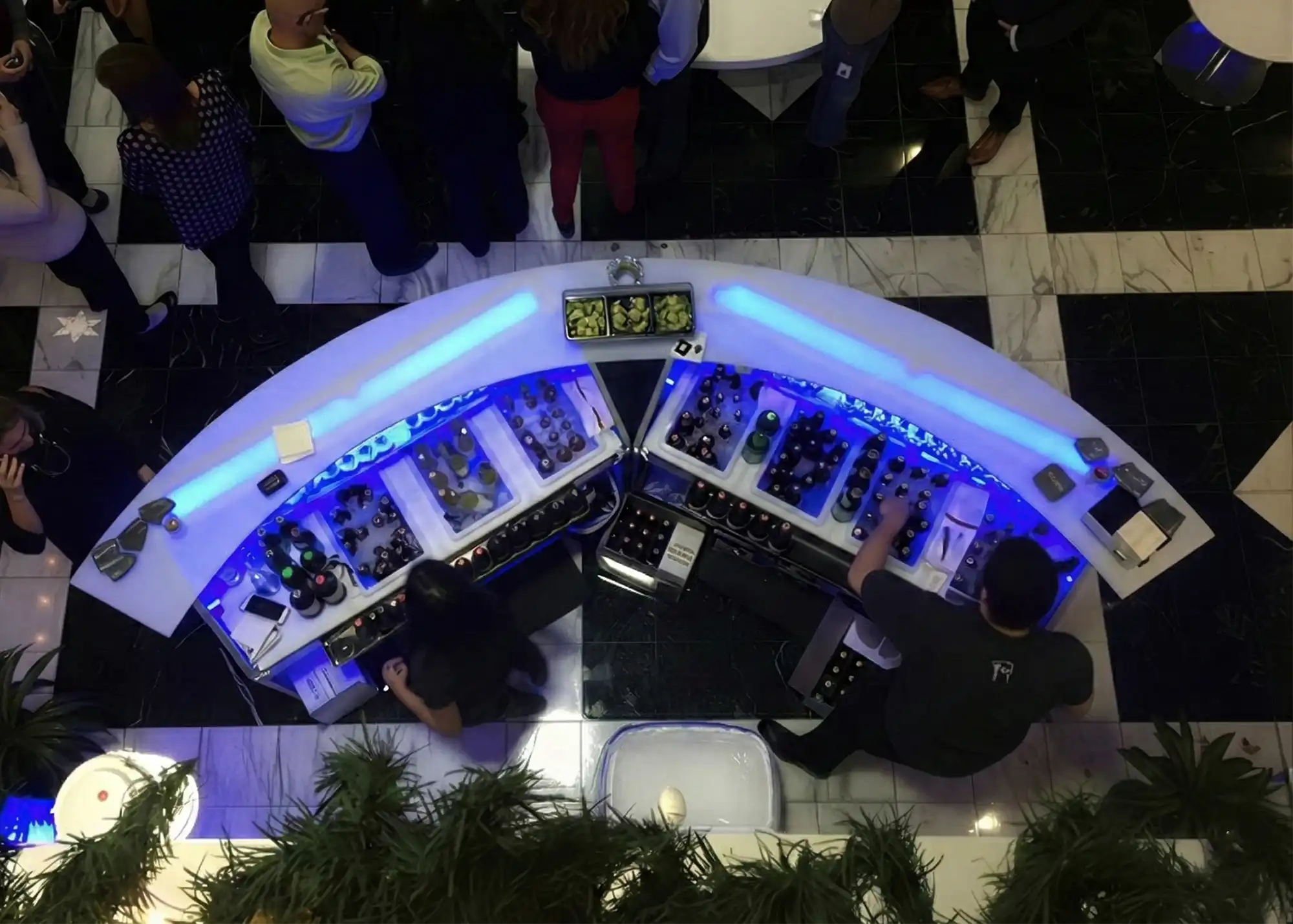
Official Oklahoma Resources
Use these official pages to verify the current rule, fee, license status, training provider, and event address.
ABLE Commission
State alcohol regulator, licensing authority, and enforcement agency.
https://oklahoma.gov/able-commission.html → 🎓Individual License Guide
Current Event Bartender and Employee license fees and requirements.
https://oklahoma.gov/able-commission/licensing/…/individual-license-guide.html → ✅Server Training
Approved in-person EVB courses and ordinary Employee-license training.
https://oklahoma.gov/able-commission/licensing/employee-license… → 🍽Caterer License Guide
Caterer authority, current fees, food percentage, storage, and reporting.
https://oklahoma.gov/able-commission/licensing/…/miscellaneous-license-guide.html → 🎉Event License Guide
Public, Special, Charitable, and Off-Site event-license options.
https://oklahoma.gov/able-commission/licensing/…/event-license-guide.html → 🩺OSDH Food Licensing
Food-establishment, temporary-license, plan-review, and inspection guidance.
https://oklahoma.gov/health/services/licensing-inspections/…/food.html →Legal References & Downloads
Full Legal Citations
Event Bartender License
ABLE says anyone serving alcohol at a private event held at an event venue who lacks a Caterer or Mixed Beverage license needs an EVB license. Applicants must be 21, avoid the listed violent-felony disqualification, pay $50 plus $3.50, complete in-person training, and may work for a bartending service. The license lasts one year, and drinking while serving is prohibited.
View Event Bartender Fact Sheet (PDF) →Event Venue and BYOB Rules
ABLE defines an event venue as a nongovernmental site offered to the public for rental, reservation, lease, or contractual event use, excluding property owned by a 501(c)(3). If alcohol is available there, it must be served by an authorized Event Bartender, Caterer, or Mixed Beverage licensee. Service is not allowed from 2:00 a.m. to 8:00 a.m.
View Event Venue Fact Sheet (PDF) →Individual Fees and Training
ABLE’s current guide lists EVB application and renewal at $50 plus a $3.50 convenience fee and requires photo ID plus a training certificate within 14 days after approval. The training page distinguishes approved in-person EVB programs from online programs that do not qualify for EVB.
View Individual License Guide →Caterer License, Fees, Food, and Reports
A Caterer license authorizes temporary-event mixed-beverage sales incidental to food. ABLE lists a $1,005 initial fee plus $25 surcharge, $905 renewal plus $25, and a $23 Storage license. Food must be at least 35% of combined annual sales; annual revenue and monthly event reports are required.
View Caterer and Storage Requirements →Combination License, Storage, and Authorized Purchasing
ABLE lists the Caterer/Mixed Beverage Combination license at $1,250 plus a $25 surcharge and $250 administrative fee. Its business guide identifies authorized wholesaler, distributor, and self-distribution channels and describes Storage-license eligibility and bonded-warehouse conditions.
View Business License Guide →Public, Special, and Charitable Event Licenses
ABLE’s event guide lists eligibility, event-count limits, durations, 60-day Public Event application timing, 10-day event notices, and approval documents for for-profit Public Events and qualifying nonprofit or charitable events. ABLE’s central fee table lists the annual Public Event fee as $1,005 plus a $25 surcharge and the one-time Public Event fee as $255.
View Event License Guide →View Current ABLE Fee Table →
Employee License Ages and Duties
The EMP license generally starts at 18 outside grocery and convenience stores. A person must be 21 to sell or serve spirits; an employee 18 or older may open and serve beer and wine or serve a drink premixed in a shaker tin by an employee at least 21. Training is due within 14 days.
View 37A O.S. § 2-121 →Hours, Minors, Identification, and Intoxication
Oklahoma prohibits covered on-premises sale, service, dispensing, and consumption from 2:00 a.m. to 8:00 a.m. ABLE explains that Odell’s Law prevents a citation merely for failing to check ID but does not excuse service to a person under 21; selling or furnishing to an intoxicated person is prohibited.
View 37A O.S. § 6-110 →View ABLE FAQs →
Mobile Bars and Vehicle Service
ABLE’s EVB fact sheet says the Event Bartender license cannot be used to operate a mobile bar. ABLE’s general FAQ says mobile bars for alcohol sales are not allowed and mobile food trucks may not serve or sell alcohol because licenses issue to approved permanent physical addresses.
View ABLE Mobile-Bar Guidance →County Restrictions and Local Event Approval
ABLE explains that counties may restrict individual-drink sales on Sundays and certain holidays and directs users to confirm with the county court clerk. The Public Event approval form says events are authorized only in liquor-by-the-drink counties, lists ordinary Public Event hours as 10:00 a.m.–2:00 a.m., and requires recommendations from the applicable local licensing and law-enforcement authorities.
View County Restrictions →View Public Event Approval Form (PDF) →
Food Establishment and Temporary Food Licensing
OSDH directs food-business applicants to the county health department for classification and possible plan review. Licensing may require an application, fees, pre-licensure inspection, and compliance. A temporary retail food license is $50 for the first day and $25 for each additional day, up to 14 days.
View OSDH Food Licensing →Administrative Penalties
ABLE states that monetary penalties are more typical than suspension or revocation for a first administrative violation, while repeated violations receive increasingly severe treatment and a fourth major violation within 24 months requires revocation.
View ABLE Penalty FAQs →Governing Laws and Rules
ABLE identifies Article 28A of the Oklahoma Constitution, Title 37A of the Oklahoma Statutes, and Title 45 of the Oklahoma Administrative Code as the principal legal authorities governing Oklahoma alcoholic beverages.
View Oklahoma Alcohol Laws and Rules →Online Application and License Issuance
ABLE requires online licensing through Accela. Applicants may upload documents, pay fees, track status, and print approved licenses there. ABLE warns that an application or receipt is not a license and does not authorize work or operation before approval.
View Online Licensing Portal →Verify an Unusual Contract Before the Event
The new EVB framework is clear for a typical host-supplied wedding at a rented event venue. For a residence, 501(c)(3)-owned property, trailer-based presentation, bundled alcohol purchase, or hybrid licensed/unlicensed setup, send ABLE the exact address, contract, invoice flow, equipment description, and alcohol ownership facts.