







Vermont Mobile Bartending Laws
Vermont requires all mobile alcohol sales be “tethered” to a brick-and-mortar location with a Commercial Caterer License. The wet hire model demands a commercial kitchen, per-event permits from Local Control Commissioners, and mandatory food availability.
2026年2月現在
Choose Your License Path
Bottom Line: No DLL license needed if you’re not selling alcohol. You provide bartending labor and equipment while the host owns all alcohol. Critical: The Private Dwelling Exemption protects this model at residences, but commercial venues increasingly prohibit Dry Hire due to liability concerns.
The Service Model
Dry Hire means you provide bartending expertise, ポータブルバー, glassware, and mixers—but the host purchases and owns all alcohol. Since no “sale” or “furnishing” for consideration occurs by your company, you operate within Title 7 exemptions. Private Dwelling Exemption:
Title 7 § 61(b)(1) states prohibitions do not apply to “the furnishing of alcoholic beverages by an individual in his or her private dwelling unless the dwelling becomes a place of public resort.”
Full citation below
The “No Sale” Prerequisite:
For Dry Hire to remain lawful, you must strictly avoid any “sale” transaction. Even reimbursement at cost is viewed as prohibited resale. The host must purchase alcohol directly from a licensed retailer. Prohibition on Markup:
“The mobile bar operator cannot purchase alcohol and resell it to the client. Even ‘reimbursement at cost’ is viewed as a prohibited resale without a license. The chain of custody for the purchase must go directly from a licensed retailer to the end consumer (the host).”
Full citation below
What You CANNOT Do
No Purchasing for Resale: You cannot buy alcohol and bill the host—even at cost. The host must personally complete the transaction at a licensed retailer. Separation of Fees:
“Invoices from Dry Hire operators must strictly delineate charges for ‘Equipment Rental,’ ‘Labor,’ and ‘Consumables’ (mixers, ice). There can be no line item for ‘Beverages’ that includes alcohol content.”
Full citation below
The “Public Resort” Trap: If a private property is rented commercially for weddings every weekend, it may legally transition to a “place of public resort,” dissolving the exemption. Public Resort Limitation:
“If a private property is rented out commercially for weddings every weekend, it may legally transition from a ‘private dwelling’ to a ‘place of public resort.’ In such cases, the exemption dissolves, and a licensed caterer (Wet Hire) becomes required.”
Full citation below
Commercial Venue Restrictions: Many established wedding venues prohibit BYOB or Dry Hire, requiring licensed and insured professional caterers. University and municipal properties typically ban this model entirely. Venue Policies:
“Research indicates that many established wedding venues (barns, event centers) explicitly prohibit BYOB (Bring Your Own Beverage) or Dry Hire arrangements. These venues typically require a ‘licensed and insured professional caterer’ to handle alcohol.”
Full citation below
Bottom Line: Vermont’s “tethered model” requires mobile alcohol sales be anchored to a brick-and-mortar location. You must hold a First Class License at a fixed premises, add a Commercial Caterer endorsement, and obtain a “Request to Cater” permit for EVERY single event.
🚫 No Standalone Mobile License
The most critical finding: Vermont does NOT issue standalone “Mobile Bar Licenses” or “Liquor Truck Licenses.” All mobile alcohol sales must be tethered to a physical commercial location. The Anchor Requirement:
“Vermont law necessitates that any entity selling alcohol (Wet Hire) must hold a foundational license tied to a physical, brick-and-mortar commercial premise or a certified commercial catering kitchen. The concept of a ‘roaming beer truck’ operating on a standalone license does not exist within the state’s legal framework.”
Full citation below
What This Eliminates: Pure mobile startups without a restaurant or commercial kitchen. You cannot buy a trailer, apply for a mobile permit, and start catering. You need an existing First Class licensed location first.
The Three-Tier Licensing Structure
Vermont requires THREE separate approvals to legally sell alcohol at mobile events:
1. First Class License
Your “anchor” location. Must be a physical premises (restaurant, bar, or licensed commissary kitchen) with Vermont Department of Health approval. Commercial Kitchen Requirement:
“The licensee must demonstrate possession or legal lease of a ‘commercial kitchen’ that meets VDH standards. A residential kitchen is insufficient unless it has been fully converted, inspected, and licensed as a separate commercial entity.”
Full citation below
Classes:
- • First Class: Beer & wine
- • Third Class: Spirits/cocktails
2. Commercial Caterer License
Annual endorsement (~$220 state + $220 local) that extends your First Class privileges to off-site events. Without this, you cannot leave your licensed premises. Scope of License:
“This license permits the holder to sell alcoholic beverages at functions outside their primary licensed premises. It effectively extends the privileges of the First-Class license to temporary locations.”
Full citation below
Fee Structure: Dual payments to both DLL and municipality where your base is located.
3. Request to Cater Permit
Required for EACH individual event. Submitted via DLL portal, approved by Local Control Commissioners of the event’s town. Late applications routinely denied. Per-Event Requirement:
“For every single event (wedding, festival, corporate party), the mobile operator must submit a ‘Request to Cater’ permit application. The application is routed to the Local Control Commissioners of the town where the event will take place.”
Full citation below
タイムライン 5-15 days advance notice required. Fee: ~$20 per event.
🍽️ Mandatory Food Availability
Vermont ties alcohol to food service. “Suitable food” must be available during alcohol sales. The “booze-only” mobile bar model violates this requirement. Food Requirement:
“Title 7 statutes and DLL regulations stipulate that First-Class and Third-Class licenses are granted to premises that are ‘operated for the purpose covered by the license,’ which implies a capability to serve food. The law generally mandates that ‘suitable food’ be available for consumption on the premises during the hours of alcohol sale.”
Full citation below
🚚 Wholesaler Purchase Requirement
You CANNOT restock at retail stores. All alcohol must be purchased from licensed Vermont wholesale dealers. Running to a grocery store during an event is a violation. Mandatory Wholesaler Purchasing:
“A First-Class licensee/Caterer is statutorily required to purchase all malt, vinous, and ready-to-drink spirits from licensed Vermont wholesale dealers or packagers. They are explicitly prohibited from purchasing alcohol from retail stores (Second-Class licensees) for resale.”
Full citation below
⚠️ Green Mountain Pitfalls
Vermont’s dual-authority structure and “tethered model” create unique compliance nightmares for mobile operators.
1. The Dual Approval Trap
Every event needs approval from BOTH the state DLL AND the Local Control Commissioners of the event’s town. One “no” kills the permit. Bifurcated Authority:
“Compliance is a dual-track process requiring simultaneous approval from the state-level Division of Liquor Control (DLC) and municipal Local Control Commissioners. A mobile operator cannot function without the explicit consent of the town government where the business is based and the town government where each event occurs.”
Full citation below
2. The Kitchen Requirement
You need a VDH-approved commercial kitchen even for “beverage only” operations. Your home kitchen doesn’t count unless separately licensed. Commissary Requirement:
“A residential kitchen is not a valid commissary unless it holds a separate ‘Home Caterer’ or ‘Commercial Caterer’ license, which requires it to be physically separated from living quarters and equipped with commercial-grade sanitation facilities.”
Full citation below
3. The Permit Timeline
Request to Cater permits need 5-15 days advance notice. Last-minute bookings are literally impossible to execute legally. Timeline Requirement:
“Regulations typically require the request to be received 5 to 15 days prior to the event to allow for municipal processing. Late applications are routinely denied.”
Full citation below
4. Local Option Tax Variability
Some towns add 1% Local Option Tax on alcohol. Your POS system must geographically adjust rates. Burlington = 11%, surrounding towns = 10%. Tax Map Complexity:
“Mobile operators must utilize Point-of-Sale (POS) systems capable of geolocation-based tax adjustments. Failing to collect the extra 1% in a town like Stowe makes the operator personally liable for the uncollected tax during an audit.”
Full citation below
5. Dry Town Restrictions
Baltimore is fully dry. Ten towns prohibit spirits (Addison, Albany, Corinth, Granby, Groton, Lincoln, Monkton, Pomfret, Rupert, Weybridge). No cocktails allowed. Semi-Dry Towns:
“A cluster of towns prohibits the sale of spirits (liquor) but allows malt and vinous beverages. These include Addison, Albany, Corinth, Granby, Groton, Lincoln, Monkton, Pomfret, Rupert, and Weybridge. A mobile bar with a ‘Wet Hire’ contract for a wedding in Pomfret is legally prohibited from serving cocktails or liquor.”
Full citation below
6. Retail Purchase Prohibition
You cannot buy alcohol from package stores for resale. Must purchase from licensed wholesalers only—even if you run out mid-event. No Retail Restocking:
“A mobile bar cannot run to a grocery store to restock beer if they run out during an event. All purchases must be from licensed wholesalers.”
Full citation below
Age Requirements & Training Mandates
Vermont enforces strict age and certification requirements for all alcohol service personnel.
| Age | What’s Allowed | Requirements |
|---|---|---|
| 21+ Years | All Service | Can sell, prepare, mix, and serve all types of alcohol without restrictions. Must complete First Class Seminar (2-year certification). Training Requirement: “Every person involved in the sale or service of alcohol (bartenders, servers) must complete the DLC’s First Class Seminar (or an approved equivalent). This certification is valid for two years and must be renewed.” Full citation below |
| 18-20 Years | Full Bartending | Can prepare, mix, and dispense alcoholic beverages. Vermont allows 18-year-olds to bartend with proper training. 18+ Bartending: “An individual must be at least 18 years of age to prepare, mix, or dispense alcoholic beverages. This statutory minimum applies strictly to anyone behind the bar.” Full citation below |
| 18歳以下 | 禁止 | Cannot prepare, mix, dispense, or deliver alcoholic beverages. No exceptions for mobile operations. |
📚 On-Site Certification Proof
Licensees must keep copies of training certificates for all staff working an event on-site, available for inspection by DLC investigators. On-Site Proof:
“Licensees are generally required to keep copies of training certificates for all staff working an event on-site, available for inspection by DLC investigators.”
Full citation below
よくある質問
Dry Hire Basics
Do I need a DLL license for Dry Hire in Vermont? ▼
そうだ。. If you’re not selling or “furnishing for consideration,” you operate within Title 7 § 61’s Private Dwelling Exemption. The host must purchase all alcohol directly from retailers. Private Dwelling Exemption:
“Subsection (b)(1) states that the chapter’s prohibitions do not apply to ‘the furnishing of alcoholic beverages by an individual in his or her private dwelling unless the dwelling becomes a place of public resort.'”
Full citation below
Wet Hire Licensing
Can I get a standalone mobile bar license in Vermont? ▼
そうだ。. Vermont does not issue standalone mobile licenses. You must first hold a First Class License at a fixed premises (restaurant/bar/commercial kitchen), then add a Commercial Caterer endorsement. Tethered Model:
“The mobile bartending sector in Vermont operates under a distinct regulatory paradigm known as the ‘tethered’ model. Vermont law necessitates that any entity selling alcohol must hold a foundational license tied to a physical, brick-and-mortar commercial premise.”
Full citation below
What are the three licenses I need for mobile catering? ▼
THE THREE-TIER STRUCTURE:
- First Class License: Your “anchor” at a physical location (~$220/yr to state + local fees) First Class Base:
“To obtain the privilege to cater alcohol (Wet Hire), an entity must first possess a foundational license tied to a physical location. This is typically a First-Class Restaurant/Bar License.”
Full citation below - Commercial Caterer License: Annual endorsement extending privileges to off-site events (~$220 state + $220 local)
- Request to Cater Permit: Required for EVERY SINGLE EVENT (~$20 per event, 5-15 days advance notice) Per-Event Permits:
“Holding a Commercial Caterer License does not grant blanket authority to roam the state. Vermont employs a rigorous per-event permitting system. For every single event (wedding, festival, corporate party), the mobile operator must submit a ‘Request to Cater’ permit application.”
Full citation below
Total annual cost (excluding per-event fees): approximately $440-880 depending on municipal fees.
Do I need a commercial kitchen for a beverage-only mobile bar? ▼
そうだ。. Even “Beverage Only” operations require a VDH-licensed commercial kitchen or commissary as your operational base. Home kitchens don’t qualify unless separately licensed. Commercial Kitchen Requirement:
“The VDH generally will not license a mobile unit without a verified commissary. A private residential kitchen is not a valid commissary unless it holds a separate ‘Home Caterer’ or ‘Commercial Caterer’ license.”
Full citation below
How far in advance must I apply for event permits? ▼
5-15 DAYS MINIMUM. Request to Cater permits require advance submission to allow Local Control Commissioners time to review. Late applications are routinely denied. Wedding in 3 days? You cannot legally accept it. Timeline Requirement:
“Regulations typically require the request to be received 5 to 15 days prior to the event to allow for municipal processing. Late applications are routinely denied.”
Full citation below
Operations & Compliance
Where can I buy alcohol for catering events? ▼
WHOLESALERS ONLY. You are statutorily required to purchase from licensed Vermont wholesale dealers. You CANNOT buy from retail stores (package stores, grocery stores) for resale—even if you run out during an event. Mandatory Wholesaler Purchasing:
“A First-Class licensee/Caterer is statutorily required to purchase all malt, vinous, and ready-to-drink spirits from licensed Vermont wholesale dealers or packagers. They are explicitly prohibited from purchasing alcohol from retail stores (Second-Class licensees) for resale. This means a mobile bar cannot run to a grocery store to restock beer if they run out during an event.”
Full citation below
Do I have to serve food at mobile bar events? ▼
そうだ。. Vermont mandates “suitable food” be available during alcohol sales. The “booze-only” mobile bar violates this requirement. Food Mandate:
“Title 7 statutes and DLL regulations stipulate that First-Class and Third-Class licenses are granted to premises that are ‘operated for the purpose covered by the license,’ which implies a capability to serve food. The law generally mandates that ‘suitable food’ be available for consumption on the premises during the hours of alcohol sale.”
Full citation below
COMPLIANCE STRATEGIES:
- Partner with licensed food truck at events
- Carry on-board “Limited Operation” menu (charcuterie, sandwiches)
- Coordinate with venue’s food service
What’s the drink “stacking” rule in Vermont? ▼
TWO DRINK MAXIMUM. Vermont regulations prohibit serving more than two drinks to a single customer at one time. A bartender cannot serve a third drink until the customer has substantially finished one of the previous two. The Two Drink Rule:
“A licensee cannot serve more than two (2) drinks to a single customer at one time. Furthermore, a bartender cannot serve a third drink until the customer has substantially finished one of the previous two. This rule effectively bans the service of ‘buckets of beer’ or pitchers to a single individual.”
Full citation below
Equipment & Infrastructure
What plumbing does my mobile unit need? ▼
BEVERAGE ONLY UNITS REQUIRE:
- One-compartment sink with dishpan for sanitizing (3-compartment required for food units) Reduced Sink Requirement:
“Beverage Only Units: Are permitted a reduced standard of a one-compartment sink, provided it is equipped with a dishpan specifically for sanitizing. A separate handwashing sink is ‘highly recommended’ but not strictly mandatory.”
Full citation below - Potable water system: Minimum 30 gallons, food-grade tanks, hot water capability
- Wastewater retention: Tank 15% larger than potable supply (35 gallons for 30-gallon supply)
- Commissary: Approved location for filling, draining, and cleaning
Garden hoses prohibited. All materials must be food-grade.
Why use portable bars instead of building a trailer in Vermont? ▼
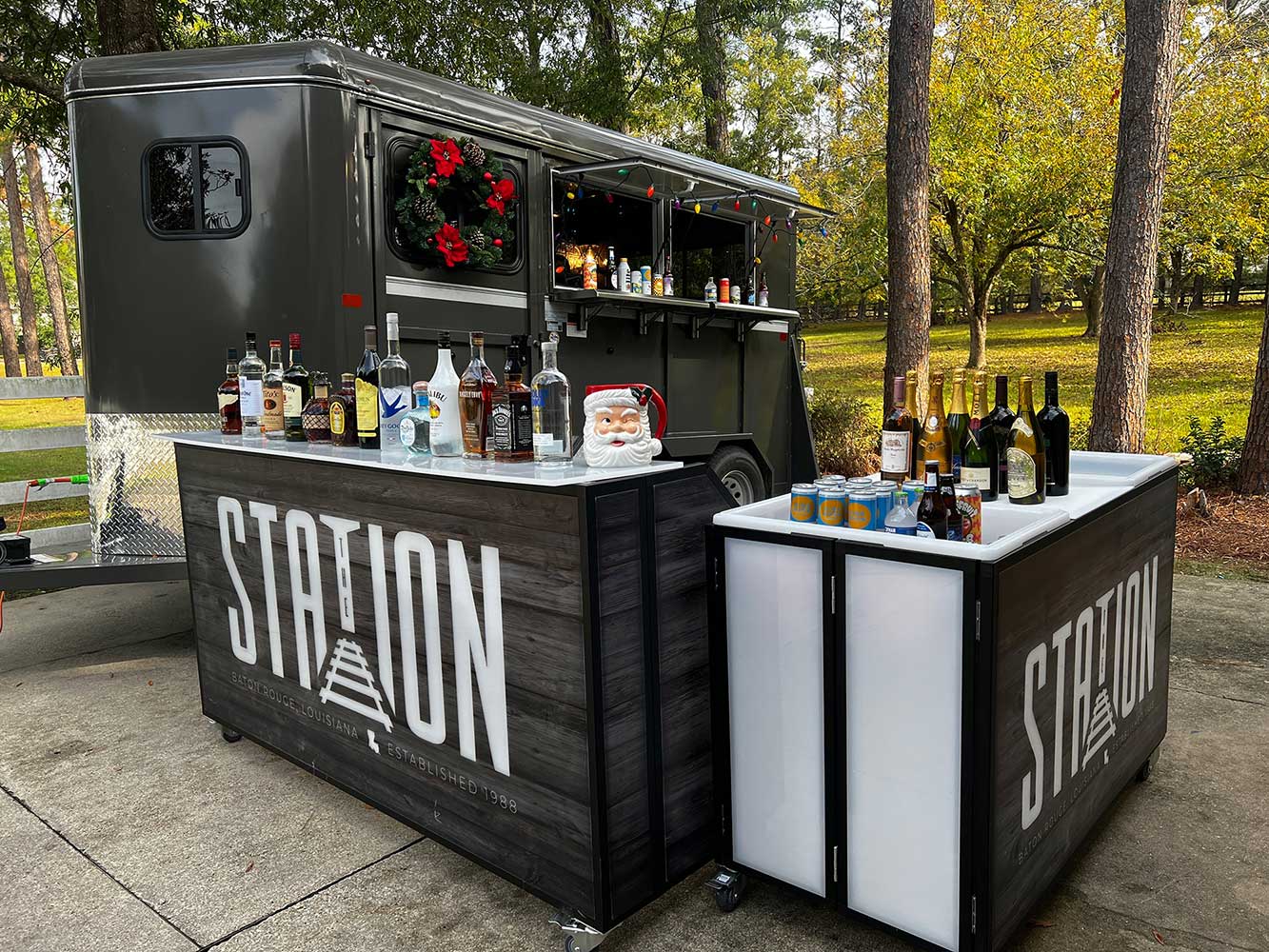
REGULATORY SIMPLICITY + VENUE ACCESS. Portable bars avoid VDH mobile unit inspections and plumbing complexity while accessing venues where trailers can’t go—upstairs ballrooms, historic homes, mountainside weddings. You still need all the licenses, but you skip the $15k+ trailer build-out and commissary headaches.
Age & Staffing
Can 18-year-olds bartend at Vermont events? ▼
そうだ。. Vermont allows anyone 18+ to prepare, mix, or dispense alcoholic beverages. They must complete First Class Seminar training and renew certification every 2 years. 18+ Bartending:
“An individual must be at least 18 years of age to prepare, mix, or dispense alcoholic beverages. This statutory minimum applies strictly to anyone behind the bar. There is no exception allowing 16 or 17-year-olds to pour alcohol under supervision.”
Full citation below
Getting Started
What’s the fastest way to start mobile bartending in Vermont? ▼
DRY HIRE WITH PORTABLE BARS. No DLL license, no commercial kitchen, no Request to Cater permits, no Local Control Commissioner approvals. Buy professional ポータブルバー equipment, get liability insurance, and focus on private residential events where the host provides all alcohol. Operational in days versus months.
Built for Vermont’s Diverse Event Landscape
From Lake Champlain weddings to Green Mountain ski resort events to Stowe barn receptions—Vermont’s event market spans mountains, valleys, and historic towns. Portable bars give you the mobility demanded by this terrain without triggering VDH mobile unit regulations or limiting you to trailer-accessible venues.
Skip VDH Mobile Unit Complexity
Avoid plumbing inspections, commissary contracts, and wastewater system requirements
Access Vermont’s Unique Venues
Set up in mountain lodges, historic barns, lakeside decks—anywhere trailers can’t reach
Navigate Town-by-Town Regulations
Move easily between municipalities with different Local Option Taxes and regulations
Official Vermont Resources
Legal References & Key Resources
Full Legal Citations & Source Documentation
Private Dwelling Exemption (Title 7 § 61)
“Subsection (b)(1) states that the chapter’s prohibitions do not apply to ‘the furnishing of alcoholic beverages by an individual in his or her private dwelling unless the dwelling becomes a place of public resort.’ This exemption allows a homeowner to serve alcohol to guests in their home without a license. By hiring a Dry Hire bartender, the homeowner is effectively delegating the physical act of pouring to an agent.”
Prohibition on Markup & Resale
“The mobile bar operator cannot purchase alcohol and resell it to the client. Even ‘reimbursement at cost’ is viewed as a prohibited resale without a license. The chain of custody for the purchase must go directly from a licensed retailer to the end consumer (the host).”
Separation of Fees Requirement
“Invoices from Dry Hire operators must strictly delineate charges for ‘Equipment Rental,’ ‘Labor,’ and ‘Consumables’ (mixers, ice). There can be no line item for ‘Beverages’ that includes alcohol content.”
“Public Resort” Limitation
“If a private property is rented out commercially for weddings every weekend, it may legally transition from a ‘private dwelling’ to a ‘place of public resort.’ In such cases, the exemption dissolves, and a licensed caterer (Wet Hire) becomes required. This creates a grey area for Airbnb-style wedding venues where Dry Hire legality is often challenged by regulators.”
Commercial Venue Prohibition of Dry Hire
“Research indicates that many established wedding venues (barns, event centers) explicitly prohibit BYOB (Bring Your Own Beverage) or Dry Hire arrangements. These venues typically require a ‘licensed and insured professional caterer’ to handle alcohol. This is driven by insurance requirements; a venue’s liability policy often demands that alcohol service be backed by a vendor with Liquor Liability coverage, which is standard for licensed Wet Hire caterers but harder to secure for unlicensed Dry Hire operations.”
The Tethered Model / No Standalone Licenses
“Vermont law necessitates that any entity selling alcohol (Wet Hire) must hold a foundational license tied to a physical, brick-and-mortar commercial premise or a certified commercial catering kitchen. Consequently, the concept of a ‘roaming beer truck’ operating on a standalone license does not exist within the state’s legal framework. All alcohol sales must be anchored to a First-Class License or a Commercial Caterer’s License.”
💡 Critical Context: This “tethered model” distinguishes Vermont from states that allow standalone mobile licenses. Pure mobile startups without existing restaurant/kitchen infrastructure cannot obtain licensing.
Commercial Kitchen Requirement
“The licensee must demonstrate possession or legal lease of a ‘commercial kitchen’ that meets VDH standards. A residential kitchen is insufficient unless it has been fully converted, inspected, and licensed as a separate commercial entity. This ‘Anchor’ requirement is a significant barrier to entry, preventing operators from simply buying a trailer and applying for a license without a supporting commercial facility.”
Commercial Caterer License Scope
“This license permits the holder to sell alcoholic beverages at functions outside their primary licensed premises. It effectively extends the privileges of the First-Class license to temporary locations. The fee structure involves payments to both the state and the municipality. The Commercial Caterer License fee is approximately $220.00 to the State (DLL) and $220.00 to the Town.”
Request to Cater Permit System
“For every single event (wedding, festival, corporate party), the mobile operator must submit a ‘Request to Cater’ permit application. The application is routed to the Local Control Commissioners of the town where the event will take place. This is a critical distinction: approval comes from the event’s location, not the business’s home base. Regulations typically require the request to be received 5 to 15 days prior to the event to allow for municipal processing. Late applications are routinely denied. A nominal fee (typically $20.00) is charged per event permit.”
Mandatory Food Service Requirement
“Title 7 statutes and DLL regulations stipulate that First-Class and Third-Class licenses are granted to premises that are ‘operated for the purpose covered by the license,’ which implies a capability to serve food. The law generally mandates that ‘suitable food’ be available for consumption on the premises during the hours of alcohol sale. For a ‘Wet Hire’ mobile bar, the ‘booze-only’ model presents a compliance risk.”
Mandatory Wholesaler Purchasing
“A First-Class licensee/Caterer is statutorily required to purchase all malt, vinous, and ready-to-drink spirits from licensed Vermont wholesale dealers or packagers. They are explicitly prohibited from purchasing alcohol from retail stores (Second-Class licensees) for resale. This means a mobile bar cannot run to a grocery store to restock beer if they run out during an event.”
Bifurcated Regulatory Authority
“Compliance is a dual-track process requiring simultaneous approval from the state-level Division of Liquor Control (DLC) and municipal Local Control Commissioners. A mobile operator cannot function without the explicit consent of the town government where the business is based and the town government where each event occurs.”
Commissary Requirement
“The VDH generally will not license a mobile unit without a verified commissary. A private residential kitchen is not a valid commissary unless it holds a separate ‘Home Caterer’ or ‘Commercial Caterer’ license, which requires it to be physically separated from living quarters and equipped with commercial-grade sanitation facilities.”
Local Option Tax Complexity
“Select municipalities have voted to impose a 1% Local Option Tax on alcoholic beverages, creating a variable tax landscape. State Tax on Alcohol: 10%. Local Option Alcohol Tax: +1%. Total Tax in Option Towns: 11%.”
“The list of towns imposing this tax includes major markets such as Burlington, Dover, Killington, Manchester, Middlebury, Rutland Town, South Burlington, St. Albans, Stowe, Stratton, Williston, Wilmington, and Winhall. Mobile operators must utilize Point-of-Sale (POS) systems capable of geolocation-based tax adjustments. Failing to collect the extra 1% in a town like Stowe makes the operator personally liable for the uncollected tax during an audit.”
Semi-Dry Town Restrictions
“A cluster of towns prohibits the sale of spirits (liquor) but allows malt and vinous beverages. These include Addison, Albany, Corinth, Granby, Groton, Lincoln, Monkton, Pomfret, Rupert, and Weybridge. Baltimore, Vermont maintains a full prohibition on alcohol sales. A mobile bar with a ‘Wet Hire’ contract for a wedding in Pomfret is legally prohibited from serving cocktails or liquor. They may only serve beer and wine.”
Beverage-Only Mobile Unit Requirements
“The VDH regulations recognize a specific sub-category for ‘Beverage Only Mobile Units.’ Beverage Only Units are permitted a reduced standard of a one-compartment sink, provided it is equipped with a dishpan specifically for sanitizing. A separate handwashing sink is ‘highly recommended’ but not strictly mandatory if the one-compartment sink can serve the function effectively.”
“Water Tanks: The unit must generally have a potable water supply of at least 30 gallons. The system must provide hot water (140°F for food units; tempered 110°F-120°F is acceptable for some handwashing setups). All tanks and hoses must be constructed of food-grade materials. Garden hoses are prohibited for filling tanks. The wastewater (greywater) holding tank must be sized to be at least 15% larger than the potable water supply tank.”
18+ Bartending Age Requirement
“An individual must be at least 18 years of age to prepare, mix, or dispense alcoholic beverages. This statutory minimum applies strictly to anyone behind the bar. There is no exception allowing 16 or 17-year-olds to pour alcohol under supervision. Staff members responsible for delivering alcohol (e.g., driving the stocked mobile unit to the venue) must also be at least 18 years old and are required to have completed the requisite alcohol safety training.”
Mandatory Server Training
“Every person involved in the sale or service of alcohol (bartenders, servers) must complete the DLC’s First Class Seminar (or an approved equivalent). This certification is valid for two years and must be renewed. Licensees are generally required to keep copies of training certificates for all staff working an event on-site, available for inspection by DLC investigators.”
Two-Drink Stacking Rule
“A licensee cannot serve more than two (2) drinks to a single customer at one time. Furthermore, a bartender cannot serve a third drink until the customer has substantially finished one of the previous two. This rule effectively bans the service of ‘buckets of beer’ or pitchers to a single individual. In a mobile bar setting, bartenders must track service to ensure guests are not accumulating multiple beverages.”